

Blog
Lyophilized Peptides Explained: Storage, Stability, and Research Quality

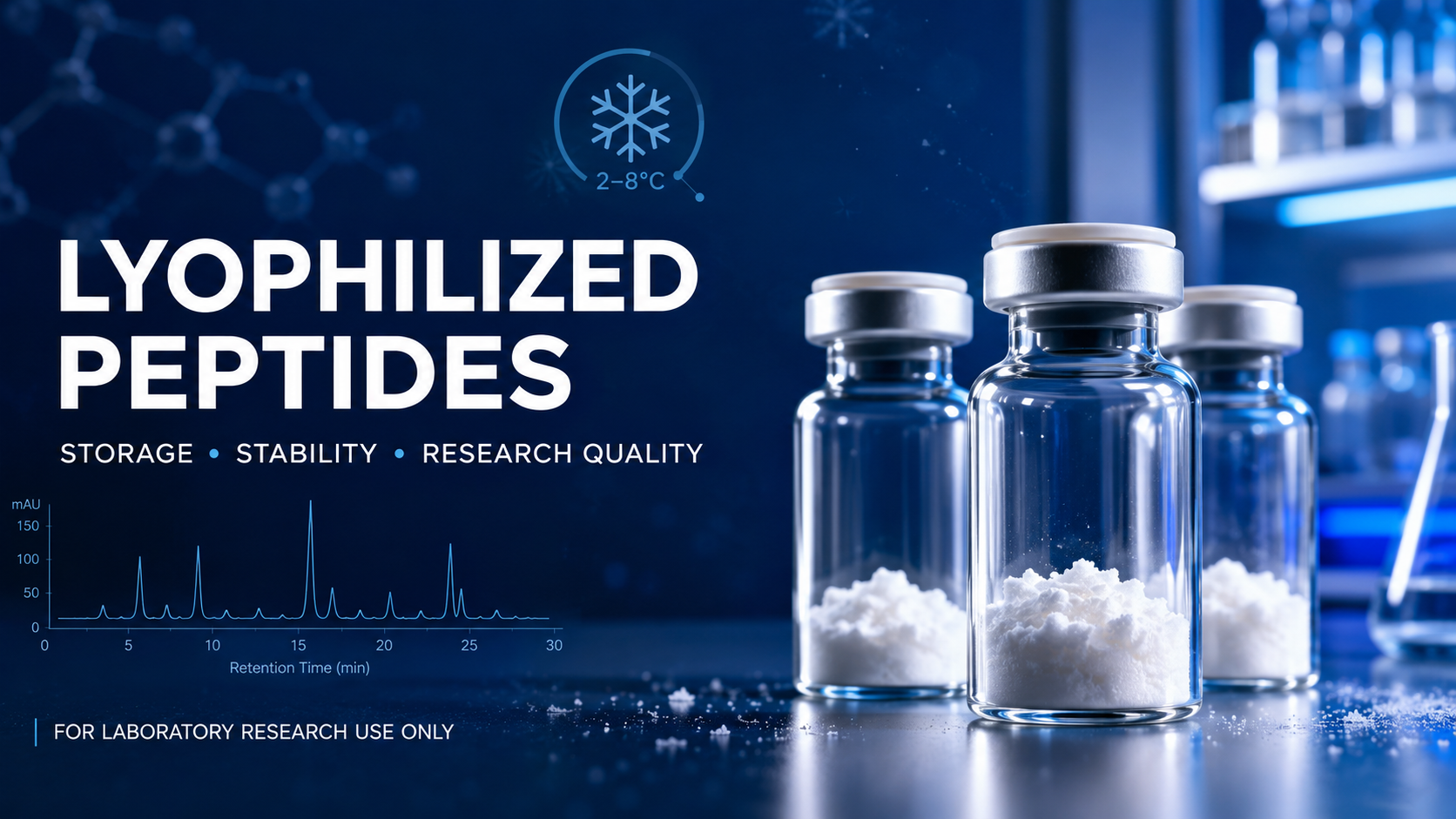
Lyophilized peptides are widely used in laboratory research because removing water can improve the stability of compounds that may be less stable in solution. However, freeze-drying does not make every peptide permanently stable or eliminate the need for controlled handling.
Temperature, moisture, light exposure, packaging integrity, transportation conditions, and the characteristics of the individual compound can all influence research quality.
This guide explains what lyophilized peptides are, how freeze-drying works, and what researchers should consider when evaluating storage conditions, analytical documentation, and product traceability.
Research-use notice: This information is provided exclusively for educational and laboratory research purposes. The materials discussed are not intended for human or veterinary use, diagnosis, treatment, prevention, or consumption.
What Are Lyophilized Peptides?
Lyophilized peptides are peptide materials that have undergone freeze-drying to remove water from a previously frozen preparation.
According to the U.S. Food and Drug Administration, lyophilization generally consists of three interconnected stages:
- Freezing the material
- Primary drying through sublimation
- Secondary drying to remove additional bound moisture
During sublimation, frozen water changes directly from ice into vapor under reduced pressure without first becoming liquid.
The resulting dry material is commonly packaged in a sealed vial. Its physical appearance may vary depending on the peptide, formulation, fill volume, drying cycle, and other manufacturing variables.
Why Are Peptides Freeze-Dried?
Peptides can be sensitive to their surrounding environment. When water is present, certain chemical degradation pathways may occur more readily.
Lyophilization is used to reduce water content and create a solid-state research material that may be better suited for storage and transportation than the same compound in solution.
Potential research and manufacturing advantages include:
- Reduced exposure to water
- Improved stability for certain compounds
- Easier transportation of dry research material
- Longer potential storage periods under validated conditions
- More controlled packaging and lot identification
- Simplified inventory management in laboratory environments
These advantages are not universal. The stability of a lyophilized peptide depends on its molecular characteristics, formulation, packaging, manufacturing process, and documented storage requirements.
Does Lyophilization Guarantee Stability?
No. Lyophilization can improve stability, but it does not make a peptide immune to degradation.
A lyophilized research compound can still be affected by:
- Excessive heat
- Moisture exposure
- Direct or prolonged light exposure
- Damaged packaging
- Repeated temperature fluctuations
- Oxygen exposure
- Extended storage beyond supported conditions
- Inappropriate transportation or handling
For this reason, researchers should follow the storage information supplied with the specific compound rather than applying one universal storage rule to every peptide.
The label, technical documentation, Certificate of Analysis, or accompanying product information should identify the relevant requirements whenever they are available.
How Temperature Can Affect Peptide Stability
Temperature is one of the most important variables in research-material storage.
Excessive heat may accelerate chemical reactions associated with degradation. Significant or repeated temperature changes may also affect the material or allow condensation to develop under certain conditions.
Researchers should evaluate:
- The storage temperature specified by the supplier
- Whether transportation conditions were controlled
- How long the shipment remained in transit
- Whether the package was exposed to unusual heat
- Whether temperature-monitoring documentation is available
- Whether the storage environment remains consistent
A refrigerated or frozen environment should not automatically be assumed to be correct for every compound. Storage decisions should be based on compound-specific documentation and validated requirements.
Why Moisture Control Matters
Lyophilized materials are created by removing water, which makes protection from environmental moisture especially important.
Moisture may enter a container if:
- The vial or closure is damaged
- The seal is compromised
- The container is repeatedly opened
- Condensation forms because of temperature changes
- The material is stored in a humid environment
- Packaging is not appropriate for the expected storage period
Researchers should inspect packaging integrity before incorporating a compound into an experiment. A loose closure, damaged stopper, cracked vial, or visibly compromised seal should be documented and reported to the supplier.
Moisture exposure may not always create an obvious visual change. Analytical evaluation is more reliable than appearance alone when determining identity, purity, or degradation.
Light and Environmental Exposure
Some peptides may be sensitive to light, including ultraviolet or prolonged high-intensity exposure. Light can contribute to chemical changes in susceptible compounds.
Protective packaging, secondary containers, amber glass, and controlled laboratory storage may help limit unnecessary exposure when appropriate for the compound.
Research materials should also be kept away from:
- Direct sunlight
- High-humidity areas
- Uncontrolled heat sources
- Repeated freeze-thaw conditions
- Areas with large temperature fluctuations
- Potential sources of chemical or biological contamination
The appropriate protections should be based on the compound’s documented properties rather than appearance or assumptions.
What Should a Lyophilized Peptide Look Like?
Freeze-dried material may appear as a compact cake, thin layer, powder, film, or irregular solid structure. Differences in appearance do not automatically indicate differences in purity or identity.
The visible structure can be influenced by:
- Formulation
- Peptide concentration
- Fill volume
- Residual moisture
- Freezing rate
- Primary and secondary drying conditions
- Vial geometry
- Transportation and vibration
Visual inspection can identify obvious packaging problems, but it cannot confirm molecular identity, peptide content, or purity.
A vial should not be considered analytically verified merely because its appearance seems uniform. Likewise, an unusual-looking cake does not, by itself, prove that the material has degraded.
Can Appearance Confirm Peptide Quality?
No. Color, texture, powder volume, and cake shape are not substitutes for analytical testing.
Peptide identity and purity are better evaluated using methods such as:
- High-performance liquid chromatography
- Mass spectrometry
- Additional compound-specific analytical methods
- Lot-specific documentation
- Stability-indicating testing when appropriate
HPLC can help characterize chromatographic purity, while mass spectrometry can help determine whether the measured molecular mass is consistent with the expected compound.
These techniques provide different information and should not be treated as interchangeable.
Why Lot-Specific Certificates of Analysis Matter
A Certificate of Analysis, commonly called a COA, records analytical results associated with a particular batch or lot.
A useful research-peptide COA may include:
- Compound name
- Lot or batch number
- Date of analysis
- Test methods
- Reported purity
- Observed molecular mass
- Expected molecular mass
- Laboratory identification
- Analytical chromatograms or spectra
- Release specifications
Researchers should confirm that the lot number on the COA matches the lot number on the vial. A generic or example COA does not establish the analytical results of a specific batch.
A reported purity percentage should also be interpreted carefully. Purity, identity, peptide content, sterility, and endotoxin status are separate quality attributes. A single HPLC percentage does not independently establish all of them.
Storage Conditions Should Be Compound-Specific
One of the most common research-handling mistakes is assuming that every lyophilized peptide requires identical storage.
Stability can differ because of variations in:
- Amino-acid sequence
- Molecular structure
- Oxidation susceptibility
- Formulation components
- Residual moisture
- Counterions
- Container-closure systems
- Manufacturing methods
Researchers should rely on the storage specifications supplied for the exact compound and lot. If adequate storage documentation is unavailable, clarification should be requested before the material is used in an experiment.
Evaluating a Research Peptide Supplier
Storage quality begins before a shipment reaches the laboratory. Supplier documentation and traceability can help researchers evaluate whether materials have been handled consistently.
Useful quality indicators include:
- Lot-specific COAs
- Clearly printed batch numbers
- Defined storage instructions
- Documented analytical methods
- Third-party analytical data
- Secure vial and package seals
- Traceable shipping records
- Responsive support for documentation questions
- Consistent labeling across the vial, COA, and order record
Researchers should be cautious when a supplier relies on broad purity claims without providing corresponding lot-specific analytical documentation.
Receiving and Documenting Research Materials
When a research shipment arrives, the receiving process should be documented consistently.
A basic receiving review may include:
- Confirming the compound and quantity against the order
- Comparing the vial’s lot number with its documentation
- Inspecting the vial and closure for visible damage
- Reviewing any relevant transportation information
- Recording the date and condition of receipt
- Moving the material to its documented storage environment
- Retaining the COA and associated records
Good documentation supports traceability and helps researchers investigate unexpected experimental results.
Frequently Asked Questions
What does lyophilized mean?
Lyophilized means freeze-dried. The material is frozen, and water is removed under reduced pressure through primary and secondary drying processes.
Are lyophilized peptides permanently stable?
No. Lyophilization may improve stability, but temperature, moisture, light, oxygen, packaging, and time can still affect a research compound.
Should every peptide be stored at the same temperature?
No. Storage requirements can vary by compound and formulation. Researchers should follow the documentation supplied for the exact material.
Can peptide quality be confirmed by looking at the vial?
No. Appearance alone cannot confirm identity or purity. Analytical testing and lot-specific documentation provide more meaningful information.
What is the difference between HPLC and mass spectrometry?
HPLC is commonly used to evaluate chromatographic purity and separate components in a sample. Mass spectrometry measures mass-to-charge information and can help confirm whether a compound’s measured molecular mass matches the expected value.
Does a high purity percentage confirm everything about a peptide?
No. A purity percentage does not independently confirm identity, peptide content, sterility, endotoxin status, or long-term stability. These are separate analytical considerations.
Why should the lot number match the COA?
A matching lot number connects the analytical report to the specific batch of material. Without that connection, the document may not represent the vial being evaluated.
Final Research Takeaway
Lyophilization is an important process for improving the storage characteristics of many research compounds, but it is only one part of material quality.
Reliable peptide research also depends on compound-specific storage requirements, secure packaging, controlled environmental conditions, transparent analytical testing, and complete lot traceability.
Researchers should evaluate the entire documentation chain—not simply the appearance of the vial or a single advertised purity percentage—before selecting materials for laboratory investigation.
Research-use disclaimer: Products and information referenced by IsoPure Peptides are intended exclusively for laboratory research. They are not intended for human or veterinary use, personal consumption, diagnosis, treatment, mitigation, or prevention of any disease. Nothing in this article constitutes medical advice.
Sources and Further Reading
- U.S. Food and Drug Administration: Lyophilization of Parenteral Products
- U.S. Pharmacopeia: Reference Standards Storage FAQs