
Laboratory Testing & Certificates of Analysis
- Certificates of Analysis
IsoPure Laboratory Testing & Analytical Documentation
A peptide Certificate of Analysis (COA) provides analytical documentation that can help researchers evaluate research-use-only materials and their associated lot information. IsoPure Peptides provides available lot-specific documentation that may include
HPLC purity results, chromatographic data, and other analytical information where applicable.analytical method provides different information about a research material. HPLC can help characterize chromatographic purity under specified testing conditions, while complementary analytical methods may provide additional information about material identity and characterization.
Researchers should evaluate analytical results together with the applicable lot number, testing methodology, chromatogram, and supporting documentation rather than relying on a single purity percentage alone.
Looking for a specific report? Review the available Certificates of Analysis below and match the documentation to the applicable material and lot number.
How to Read a Certificate of Analysis
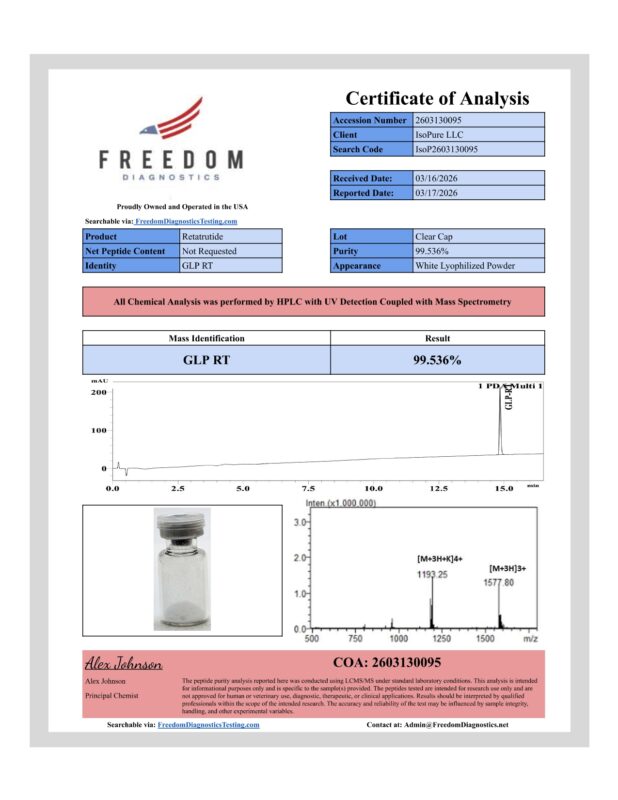
A Certificate of Analysis provides analytical information associated with a particular material or lot. The information included can vary depending on the material, laboratory, and analytical methods performed.
When reviewing a COA, researchers should first confirm that the material name and lot or batch information correspond with the material being evaluated. The report can then be reviewed for the analytical methods performed, reported results, testing dates, and other available documentation.
HPLC results may provide information about chromatographic purity under the conditions of the analytical method. Other techniques, such as mass spectrometry when performed, may provide complementary information useful for material characterization.
A COA should therefore be evaluated as a collection of analytical information rather than relying on a single reported purity percentage.
Lot & Batch Traceability
Lot and batch traceability helps connect a research material with its associated analytical documentation. When reviewing a Certificate of Analysis, researchers should confirm that the lot or batch identifier on the report corresponds with the material being evaluated.
Lot-specific documentation can help establish a clearer record between the material, analytical testing, reported results, and supporting documentation. This is particularly important when multiple production lots of the same research material exist, because analytical results associated with one lot should not automatically be assumed to represent another.
A clear documentation trail can connect the material name, lot number, Certificate of Analysis, testing date, and analytical results so researchers can more easily evaluate the information associated with a specific batch.
HPLC Purity vs. Identity Testing
HPLC purity and material identity are related analytical considerations, but they do not answer the same question. High-performance liquid chromatography (HPLC) separates components within a sample and can provide information about chromatographic purity under the conditions of a specific analytical method.
A high HPLC purity percentage indicates that the primary detected component represents a large proportion of the integrated chromatographic response under those testing conditions. However, an HPLC purity percentage alone does not conclusively establish molecular identity.
Complementary analytical techniques may be used when additional characterization is appropriate. For example, mass spectrometry can provide mass-related information that contributes to evaluating molecular identity. The specific analytical methods performed should be identified in the documentation associated with the applicable material and lot.
Researchers should therefore evaluate HPLC purity, identity-related analytical information, the chromatogram, lot information, and the Certificate of Analysis together rather than treating any single result as a complete characterization.
Certificate of Analysis FAQ
What does a Certificate of Analysis show?
A Certificate of Analysis summarizes analytical information associated with a particular material or lot. Depending on the testing performed, it may include material identification, lot or batch information, testing dates, HPLC purity results, chromatographic data, mass-related analytical information, and other reported results.
Does 99% HPLC purity confirm peptide identity?
No. A reported HPLC purity percentage describes chromatographic results obtained under a specific analytical method. It does not, by itself, conclusively establish molecular identity. Complementary analytical techniques may provide additional characterization when performed.
Why should the lot number on a COA be checked?
The lot number helps connect analytical documentation to the specific batch being evaluated. Results associated with one production lot should not automatically be assumed to represent another lot of the same material.
What should researchers look for when reviewing a COA?
Researchers can review the material name, lot or batch identifier, testing date, analytical methods performed, reported results, chromatographic information, and other available documentation. The information should be considered together rather than relying solely on a single purity percentage.
What is the difference between HPLC and mass spectrometry
HPLC separates components within a sample and can provide information about chromatographic purity under specified analytical conditions. Mass spectrometry provides mass-related information that can contribute to molecular characterization. The techniques provide different types of analytical information and may complement one another.
Research-Use Information
For research and educational information only. Analytical documentation and testing results do not establish safety, effectiveness, regulatory approval, or suitability of any material for human or animal use. Materials identified as research-use-only are intended for laboratory and research purposes only.