

Blog
Lyophilized Peptides Explained: Reference Standards, Purity & Research Documentation

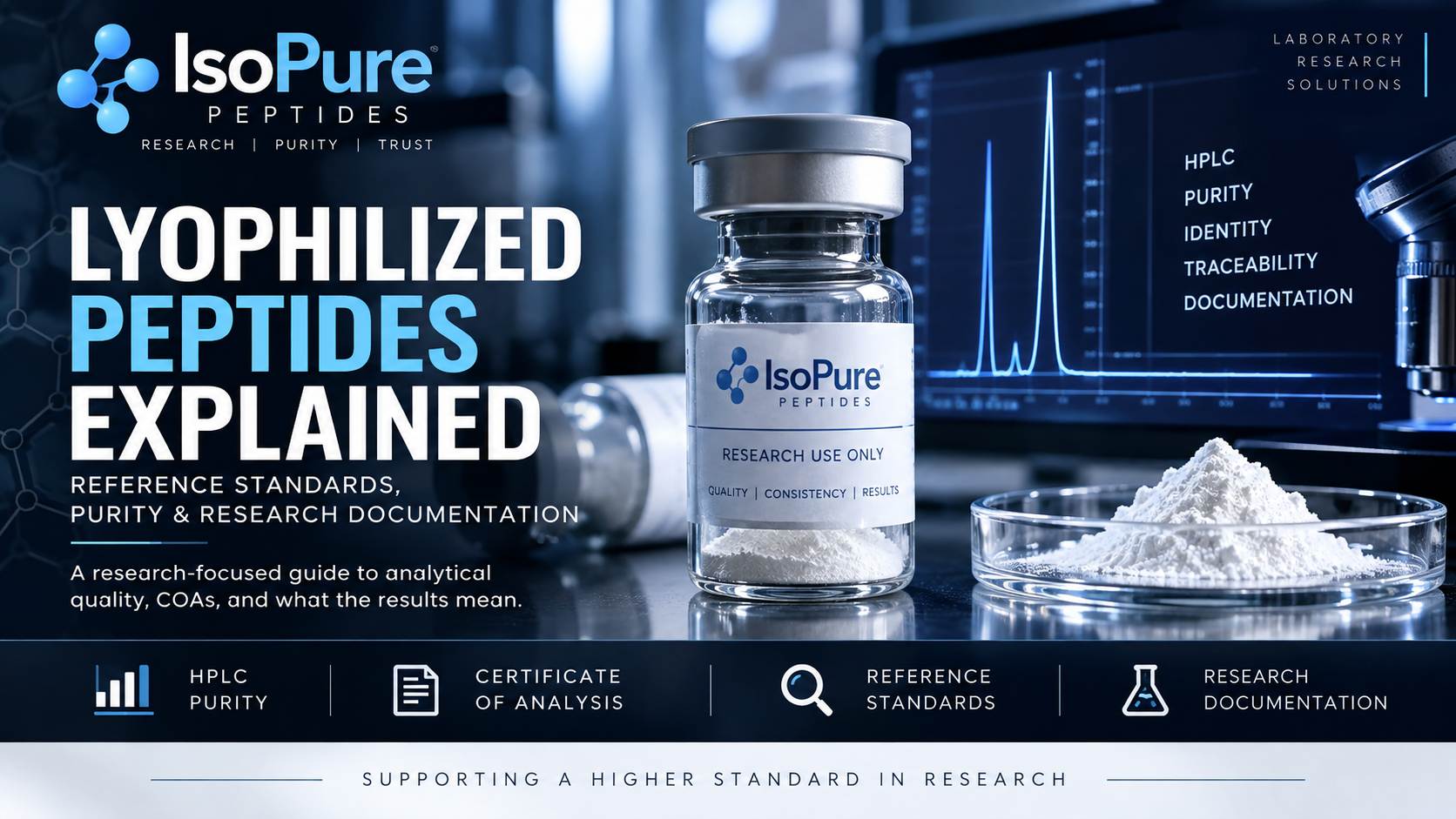
Lyophilized peptides are widely encountered in laboratory research because freeze-drying can provide a convenient solid form for storage, handling, transportation, and analytical characterization.
Researchers evaluating a lyophilized peptide reference standard or other peptide research material should understand that the physical appearance of a lyophilized material tells only a small part of the story. Analytical documentation, identity testing, chromatographic purity, lot traceability, and the testing methodology all contribute to understanding the material being evaluated.
This guide explains what lyophilized peptides are, how analytical purity is reported, what reference standards are intended to accomplish, and how researchers can critically evaluate supporting documentation.
What Is a Lyophilized Peptide?
Lyophilization is commonly known as freeze-drying.
In simplified terms, a material is frozen and water or another volatile component is removed under reduced pressure primarily through sublimation. The process can produce a dry material suitable for subsequent laboratory handling and analysis.
A lyophilized peptide may appear as a powder, cake, film, or other solid material depending on the formulation and processing conditions.
Appearance alone, however, does not establish peptide identity or purity.
Analytical testing is required to characterize those properties.
What Is a Lyophilized Peptide Reference Standard?
A reference material provides researchers with a characterized material that may be used in an analytical context, depending on its documented intended purpose and qualification.
The phrase peptide reference standard should not automatically be interpreted to mean that every material carrying that description has been certified by a recognized standards organization.
Researchers should determine exactly what documentation supports the designation.
Important questions include:
- What analytical methods were performed?
- Is the material lot-specific?
- Is chromatographic purity reported?
- Was identity evaluated using an appropriate complementary technique?
- Is there a Certificate of Analysis?
- Are testing dates and lot numbers available?
- Does the documentation identify the analytical method or conditions?
These details provide considerably more information than a purity percentage standing alone.
Understanding HPLC Purity
High-performance liquid chromatography, or HPLC, is commonly used to separate components within a sample.
A chromatogram displays detector response as compounds move through the chromatographic system.
Researchers may encounter results described as:
HPLC Purity: 99%
or
Purity: 99.1% by HPLC
That number requires context.
A reported HPLC area percentage generally describes the relative chromatographic response observed under the particular analytical conditions used.
It should not automatically be interpreted as proof of every other characteristic of the material.
Does 99% HPLC Purity Mean the Material Is 99% Pure?
Not necessarily in every possible sense.
A high chromatographic area percentage can indicate that the primary detected component accounts for a large proportion of the integrated chromatographic response under the specified method.
However, 99% HPLC purity does not by itself establish molecular identity, exact mass fraction, sterility, endotoxin status, absence of every possible impurity, biological activity, safety, efficacy, or suitability for a particular application.
This distinction is important when researchers compare materials advertised simply as 99% purity peptides.
The analytical method and supporting documentation matter.
Reading the Chromatogram
Researchers reviewing an HPLC report should look beyond the largest number printed on the document.
Important features can include the main peak, retention time, minor peaks, peak areas, baseline behavior, and the chromatographic conditions used to produce the result.
The main peak is typically the dominant chromatographic signal associated with the material being analyzed under the specified method.
Minor peaks may represent other detectable components, although additional analytical investigation may be required to determine their identities.
Retention time can also provide useful comparative information under controlled analytical conditions, but retention time alone does not conclusively establish molecular identity.
HPLC Purity vs. Molecular Identity
This is one of the most important distinctions in peptide analytical documentation.
HPLC is highly useful for chromatographic separation and purity assessment, but researchers may use complementary techniques when evaluating identity.
Mass spectrometry (MS) can provide mass-related information that contributes to molecular characterization.
Accordingly, documentation containing both chromatographic information and appropriate identity-related analytical data can answer different questions about a research material.
Neither measurement should automatically be treated as answering every analytical question.
Why Lot-Specific Documentation Matters
Research materials are produced in batches or lots.
Consequently, documentation is most useful when researchers can connect the analytical report to the particular lot being evaluated.
A strong documentation trail may include:
Product → Lot number → Certificate of Analysis → Analytical results
This provides considerably better traceability than displaying a generic purity statement that cannot be connected to a particular batch.
What Is a Certificate of Analysis?
Depending on the supplier and testing performed, a COA may contain information such as:
- Material or sample identification
- Lot or batch number
- Testing date
- HPLC purity result
- Chromatographic information
- Mass-related analytical results
- Testing laboratory information
- Analytical method references
Researchers should examine what a COA actually reports rather than assuming every COA contains the same testing.
Questions to Ask When Reviewing Peptide Documentation
When evaluating lyophilized research materials, consider several basic questions.
Does the documentation identify the exact lot?
Can the reported analytical results be traced to that lot?
Does the HPLC report provide more information than a single purity number?
Is identity supported separately from chromatographic purity where appropriate?
Are the analytical methods sufficiently described to understand what was measured?
These questions help distinguish documented analytical information from unsupported marketing claims.
Lyophilized Peptides and Research Quality
Lyophilization describes a processing state. It is not itself a quality certification.
Similarly, terms such as “high purity,” “research grade,” or “reference standard” should be evaluated alongside the underlying analytical evidence.
Researchers should prioritize transparent documentation and understand the limitations of each analytical method.
A well-documented research material allows the researcher to evaluate the available evidence rather than relying solely on a label or headline percentage.
Building a Better Analytical Documentation Trail
A useful research documentation system connects several pieces of information:
Material identity → Lot number → COA → HPLC data → Complementary analytical information
Maintaining this chain improves traceability and makes analytical results easier to evaluate later.
For organizations working with numerous research materials, consistent lot-specific recordkeeping can be particularly important.
Bottom Line
Lyophilized peptides are commonly encountered in laboratory research, but the term lyophilized describes how a material has been processed rather than proving its identity or analytical quality.
Likewise, a lyophilized peptide reference standard should be evaluated according to the documentation and characterization supporting it.
HPLC purity results, chromatograms, Certificates of Analysis, lot traceability, and complementary analytical techniques each provide different pieces of information.
The strongest approach is therefore not to ask only:
“What is the purity percentage?”
but also:
“What analytical evidence supports that number, what exactly was measured, and which lot does the documentation represent?”
Research-use disclaimer
For research and educational information only. This article does not provide medical advice or establish the safety, effectiveness, regulatory status, or suitability of any material for human or animal use.