
Blog
GHK-Cu Copper Peptide Benefits: What the Research Actually Shows

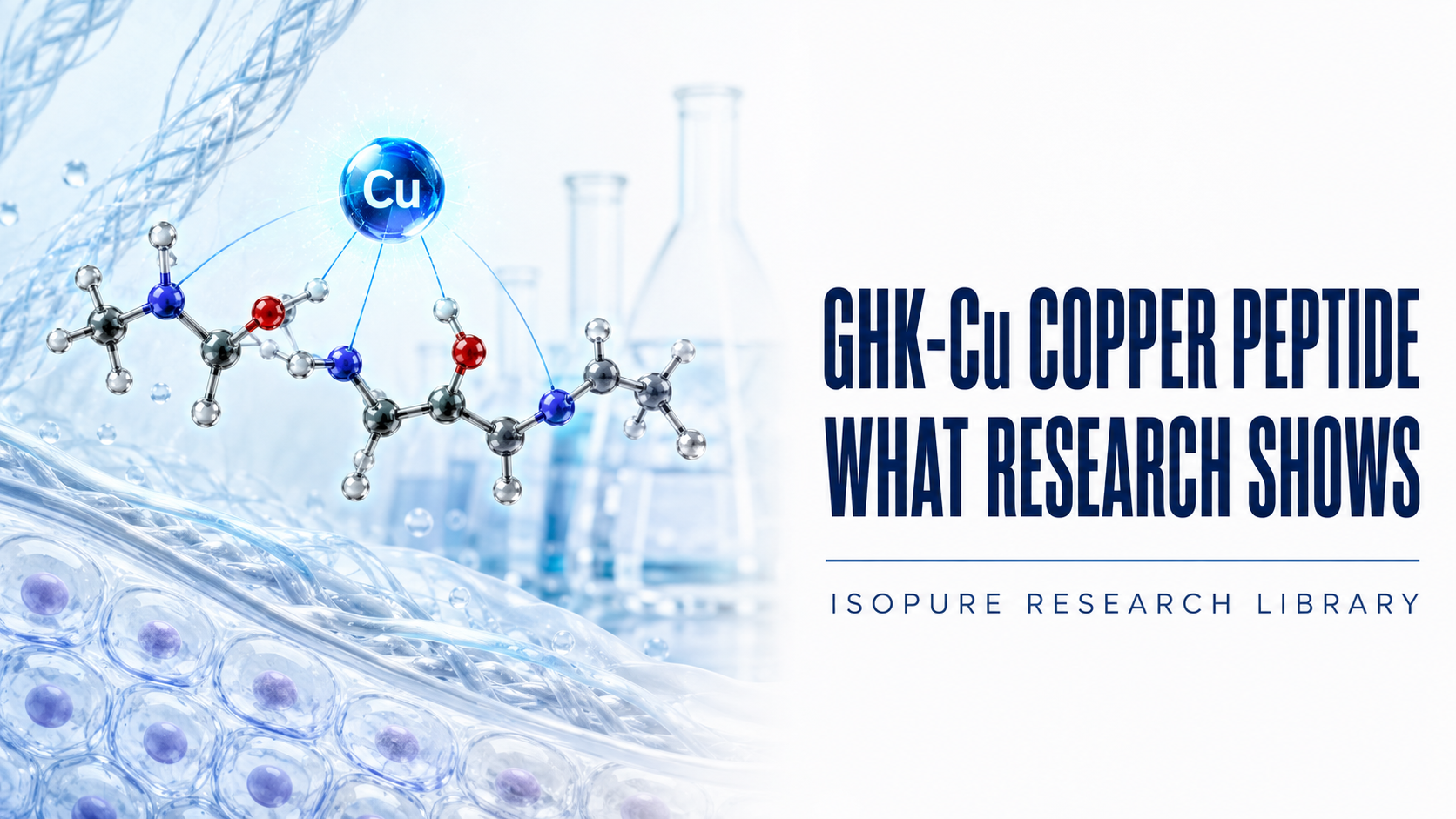
GHK-Cu is a naturally occurring copper-binding peptide studied in skin biology, extracellular-matrix regulation, cellular signaling, and experimental tissue-repair models. It is also widely used as an ingredient in topical cosmetic formulations.
Research findings are sometimes translated into broad claims about healing, hair growth, anti-aging, and recovery. However, laboratory mechanisms, cosmetic applications, and injectable administration are different contexts with different levels of evidence and regulatory concern.
Understanding those distinctions is essential when reviewing proposed GHK-Cu benefits.
What Is GHK-Cu?
GHK is the abbreviation for glycyl-L-histidyl-L-lysine, a tripeptide composed of three amino acids:
- Glycine
- Histidine
- Lysine
GHK can bind copper ions to form the complex commonly called GHK-Cu or copper tripeptide-1.
Naturally occurring GHK has been identified in human plasma and other biological fluids. Its ability to bind copper has led researchers to investigate how it may participate in copper transport, cellular signaling, antioxidant pathways, and tissue remodeling.
GHK and GHK-Cu should not automatically be treated as identical in every analytical or biological context. Copper complexation can affect a molecule’s chemical characteristics, stability, and behavior.
Why Is GHK-Cu Studied?
Researchers have investigated GHK-Cu in several laboratory and preclinical areas, including:
- Fibroblast activity
- Collagen-related pathways
- Extracellular-matrix remodeling
- Inflammatory signaling
- Oxidative-stress responses
- Angiogenesis
- Cellular migration
- Experimental wound models
- Hair-follicle biology
These research areas help explain why GHK-Cu appears in discussions about skin appearance, tissue repair, and hair.
However, identifying a biological mechanism does not prove that a particular product will produce a meaningful benefit in humans.
What Are the Proposed Skin Benefits?
GHK-Cu has been studied for its possible effects on fibroblasts and components of the extracellular matrix. Fibroblasts are cells involved in producing collagen, elastin, and other structural materials found in skin and connective tissue.
Laboratory and cosmetic research has examined whether topical GHK-Cu may influence:
- Skin firmness
- Elasticity
- Fine-line appearance
- Collagen-related activity
- Skin density
- Responses to environmental stress
- Visible signs associated with photoaging
Some publications report favorable findings, but the overall evidence has limitations. Studies may involve small populations, different formulations, proprietary mixtures, laboratory models, or outcome measurements that cannot be directly compared.
A 2025 review indexed by PubMed noted that GHK-Cu is widely promoted in topical anti-wrinkle products while also identifying an unexpected shortage of clinical studies addressing effectiveness, permeability, and formulation characteristics.
Therefore, phrases such as “supports the appearance of healthy skin” may be more scientifically responsible in a cosmetic context than claims that GHK-Cu reverses aging or repairs damaged tissue.
What Does the Research Say About Hair?
Researchers have examined GHK-Cu and related copper peptides in connection with hair-follicle size, cellular signaling, blood-vessel activity, and components of the follicular environment.
These findings have encouraged interest in topical hair-care applications. Nevertheless, laboratory findings involving follicles or cultured cells do not establish that GHK-Cu treats alopecia or reliably regrows hair in humans.
Important unanswered questions may include:
- Effective formulation
- Skin and follicle penetration
- Appropriate concentration
- Duration of exposure
- Stability
- Comparison with established treatments
- Long-term safety
- Reproducibility in controlled clinical trials
GHK-Cu should not be represented as an FDA-approved treatment for hair loss.
What About Wound Healing and Recovery Claims?
GHK-Cu has been investigated in cell, animal, biomaterial, and experimental wound models. Researchers have reported effects involving cell migration, collagen regulation, inflammatory processes, and experimental tissue remodeling.
These findings are scientifically interesting, but they should not be converted into promises that a GHK-Cu research material heals injuries, accelerates surgical recovery, repairs tendons, or treats wounds.
Evidence from an in-vitro experiment or animal model does not establish clinical safety or effectiveness. The delivery method, formulation, exposure, species, study design, and measured outcome can all affect the result.
Medical wound care requires evaluation and treatment by qualified healthcare professionals.
Topical and Injectable GHK-Cu Are Different Contexts
Topical cosmetics and injectable products are not equivalent simply because they contain similarly named ingredients.
A topical formulation must address questions such as:
- Skin penetration
- Cosmetic stability
- Compatibility with other ingredients
- Oxidation
- Preservative effectiveness
- Local irritation
Injectable administration introduces different and potentially more serious concerns, including:
- Sterility
- Endotoxins
- Aggregation
- Peptide-related impurities
- Immunogenicity
- Systemic exposure
- Dosage accuracy
- Long-term safety
The FDA states that compounded injectable products containing GHK-Cu may present immunogenicity risks arising from aggregation and peptide-related impurities. The agency also reports that human data are limited for evaluating injectable safety.
This FDA statement should not be interpreted as applying equally to every topical cosmetic formulation. It specifically emphasizes concerns associated with injectable administration.
Is GHK-Cu FDA Approved?
GHK-Cu is not an FDA-approved injectable drug for anti-aging, injury recovery, hair growth, or tissue repair.
Its presence in a cosmetic product also does not mean the FDA has evaluated or approved that product’s effectiveness. With limited exceptions, cosmetic products and ingredients do not undergo FDA premarket approval.
Researchers and consumers should distinguish among:
- A naturally occurring peptide
- A cosmetic ingredient
- A nonclinical research material
- A compounded drug product
- An FDA-approved medicine
These categories are not interchangeable.
Why Identity and Purity Testing Matter
The name “GHK-Cu” alone does not establish that a sample contains the expected copper-peptide complex.
Analytical documentation may include:
- The complete chemical name
- Peptide sequence
- Molecular formula
- Expected molecular mass
- Mass-spectrometry identity data
- HPLC chromatogram
- Chromatographic purity
- Copper-related characterization
- Lot or batch number
- Laboratory and testing dates
- Method information
HPLC purity and molecular identity answer different analytical questions. A large primary HPLC peak does not independently establish correct molecular identity, copper binding, concentration, sterility, endotoxin status, or biological activity.
For more information, read IsoPure’s guide: HPLC Purity Testing Explained: What the Results Mean.
Why Lot-Specific Documentation Matters
An analytical report should correspond to the specific production lot being reviewed. A report from a previous or unrelated batch does not establish the characteristics of the current material.
The lot number on the label should match the identifier shown on the applicable Certificate of Analysis. This supports traceability among:
- The physical research material
- Its assigned production batch
- The submitted laboratory sample
- The analytical results
- The final laboratory report
Learn more in: How to Read a Lot-Specific Certificate of Analysis (COA) for Research Peptides.
How to Interpret GHK-Cu Benefit Claims
When reviewing a proposed benefit, ask:
- Was the research conducted in cells, animals, or humans?
- Was the formulation topical, oral, injectable, or part of a laboratory experiment?
- Was GHK studied alone or as the copper-bound GHK-Cu complex?
- Was the outcome biological, cosmetic, or clinical?
- Was the study controlled and independently replicated?
- Does the claim extend beyond what the study measured?
- Is the product being presented consistently with its regulatory category?
These questions help prevent preliminary research from being mistaken for established clinical evidence.
Final Perspective
GHK-Cu is a biologically interesting copper-binding tripeptide. Laboratory and preclinical studies have examined its relationship with extracellular-matrix regulation, oxidative stress, inflammatory signaling, skin biology, hair follicles, and experimental tissue remodeling.
The evidence does not justify treating every proposed benefit as clinically proven. Topical cosmetic research, laboratory studies, animal experiments, and injectable use must be evaluated separately.
IsoPure provides research materials strictly for legitimate laboratory research. They are not intended for human or animal use and are not represented as products for diagnosing, treating, curing, or preventing disease.