


Blog
How to Read a Lot-Specific Certificate of Analysis (COA) for Research Peptides

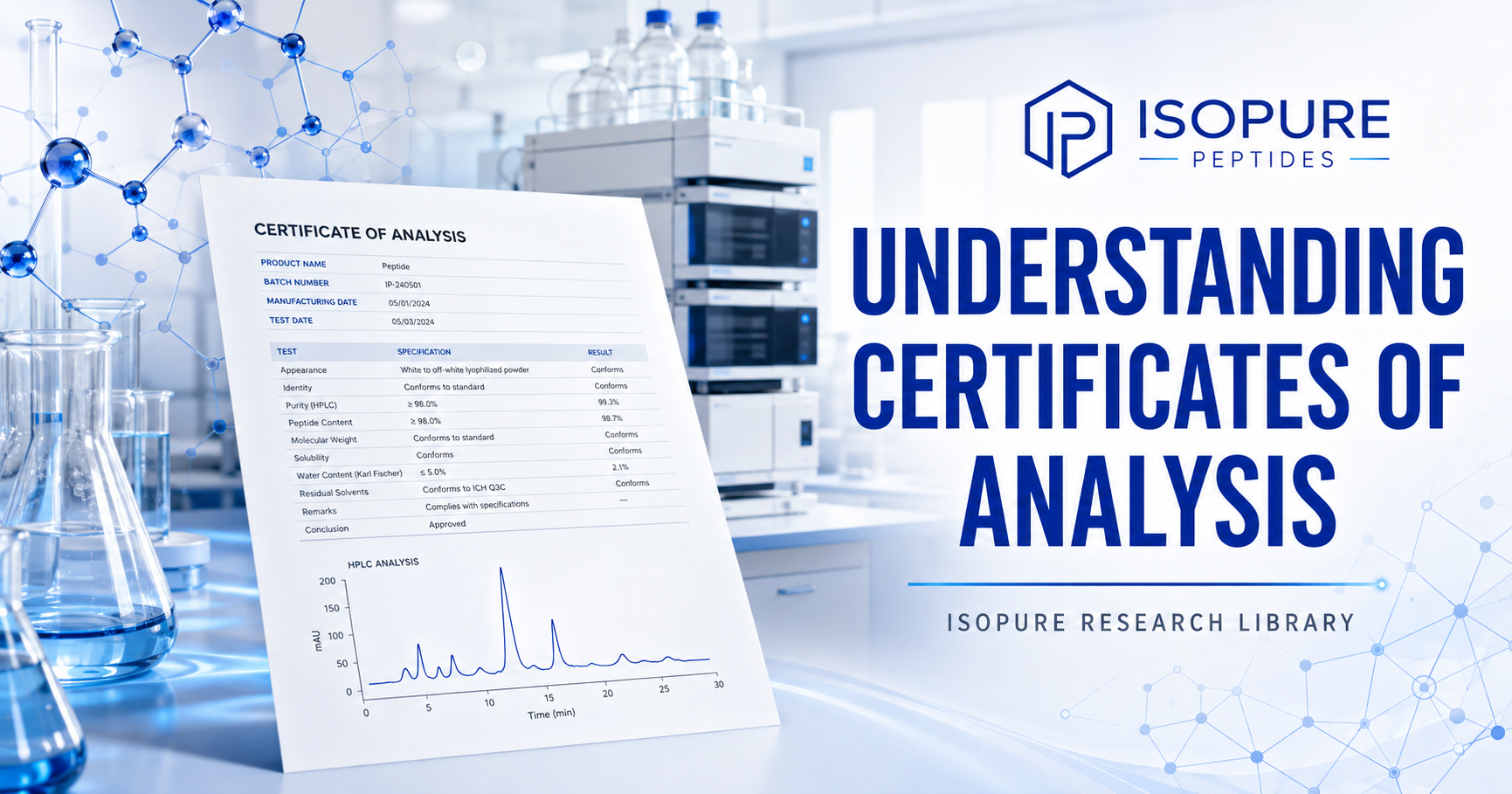
A Certificate of Analysis, commonly called a COA, is a document that reports analytical information about a particular product lot. Reviewing a lot-specific COA can help laboratories and qualified researchers understand what was tested, which methods were used, and whether the reported results correspond to the product they received.
A COA should be evaluated carefully rather than judged by a single purity percentage.
What Does “Lot-Specific” Mean?
A lot or batch number identifies a particular production group. A lot-specific COA should display an identifier that matches the lot number printed on the corresponding product label.
This connection helps establish traceability between:
- The physical product
- Its assigned production lot
- The submitted test sample
- The analytical results shown on the report
A COA that does not identify a batch or lot may not demonstrate that the results apply to the product being reviewed.
Information to Look for on a COA
A complete analytical report may include:
- Product or sample name
- Lot or batch number
- Date received and date tested
- Analytical method
- Identity result
- Purity result
- Laboratory name
- Report or sample number
- Authorized laboratory approval
The exact format can vary by laboratory and testing method.
Identity Testing Versus Purity Testing
Identity and purity answer different questions.
Identity testing evaluates whether the sample is consistent with the compound it is represented to contain.
Purity testing evaluates the relative proportion of the primary detected component compared with other detected components under the conditions of the test.
A high reported purity percentage does not, by itself, establish identity, quantity, sterility, safety, or suitability for a particular application.
Understanding HPLC Results
High-performance liquid chromatography, or HPLC, is commonly used to separate and measure components within a sample.
An HPLC report may include:
- A chromatogram showing detected peaks
- Retention times
- Peak-area percentages
- The reported purity result
- The method or instrument conditions
The largest peak generally represents the primary detected component, but proper interpretation depends on the method and supporting identity data.
Understanding Mass Spectrometry
Mass spectrometry may be used to evaluate molecular mass and support compound identification. Results are compared with the expected molecular characteristics of the submitted sample.
Mass spectrometry and HPLC provide different information. Using both can provide a more complete analytical picture than relying on purity testing alone.
What a COA Does Not Automatically Prove
A COA should not be interpreted as proof of:
- FDA approval
- Clinical effectiveness
- Safety for human or animal use
- Sterility, unless sterility was specifically tested
- Endotoxin status, unless that test was performed
- Exact quantity, unless appropriate quantitative testing was completed
- Suitability for any untested purpose
The report should only be interpreted within the scope of the analyses actually performed.
Why Traceability Matters
Traceability allows a product and its documentation to be connected through a consistent lot number. Strong documentation practices make it easier to organize records, answer product questions, and distinguish one production batch from another.
Researchers should confirm that the lot number on the product matches the lot number shown on the analytical report before evaluating the results.
IsoPure’s Documentation Approach
IsoPure provides research-product information and available lot-specific analytical documentation to support transparency and traceability. Reports should be reviewed in their entirety, including the testing method, sample identifier, dates, and limitations—not only the headline purity percentage.
Products are offered strictly for laboratory research purposes and are not intended for human or animal use.
Frequently Asked Questions
Is a purity percentage the same as identity?
No. Purity and identity are separate analytical characteristics and may require different testing methods.
Does a COA prove that a product is sterile?
Only if an appropriate sterility test was specifically performed and reported. HPLC purity testing does not establish sterility.
Why should the lot numbers match?
Matching lot numbers help connect the product being reviewed with the analytical report associated with that specific production batch.
Should I review the complete report?
Yes. The complete report provides more useful context than a purity percentage shown by itself.
3 thoughts on “How to Read a Lot-Specific Certificate of Analysis (COA) for Research Peptides”