

Blog
BPC-157 vs. TB-500: Research Differences, Evidence Limits, and FDA Status

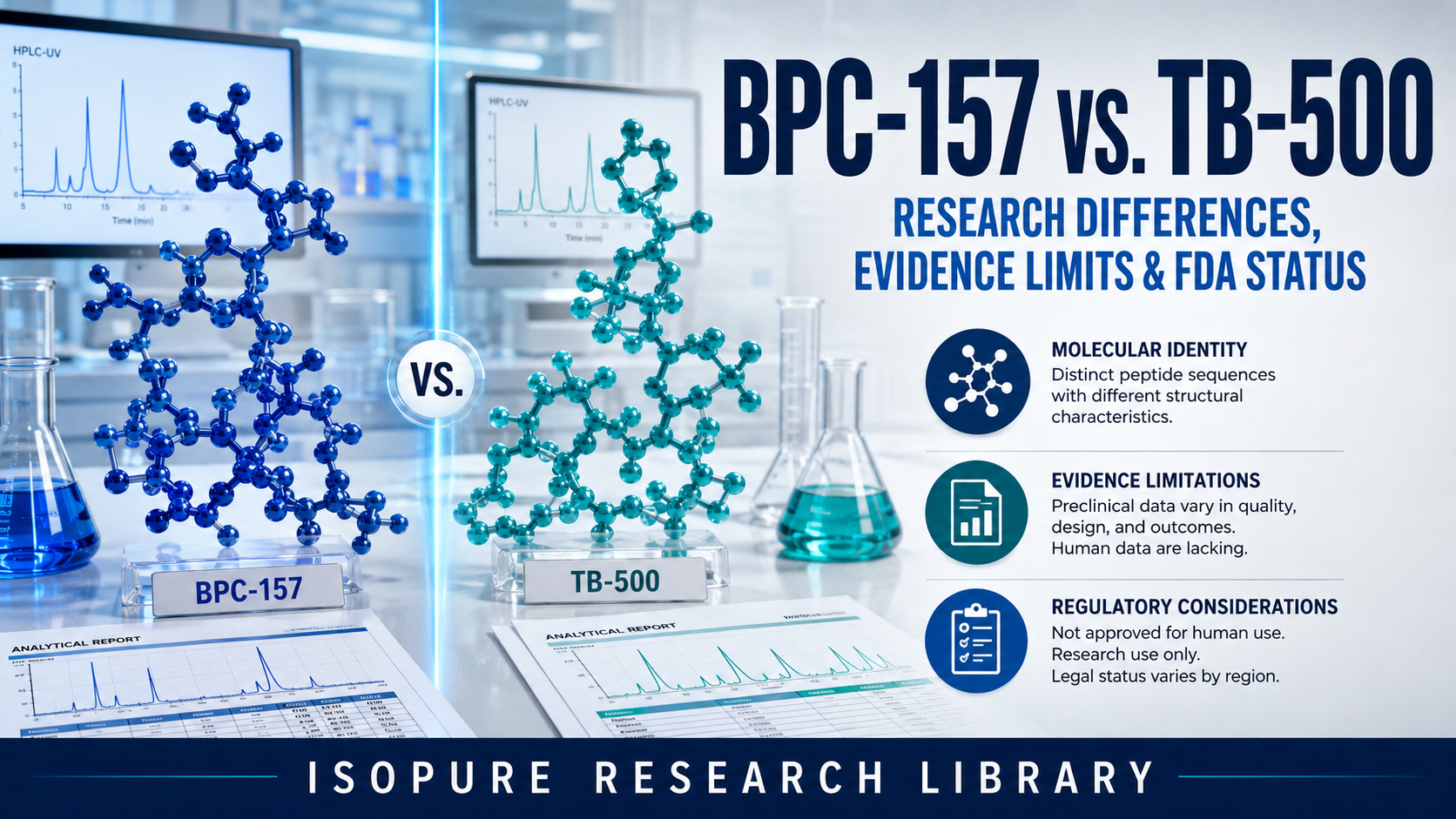
BPC-157 and TB-500 are frequently mentioned together in online discussions about recovery, tissue repair and the marketing nickname “Wolverine peptide.”
Despite being grouped together, BPC-157 and TB-500 are different research materials. They differ in amino-acid composition, scientific background, proposed mechanisms and available evidence. Neither should be treated as an FDA-approved treatment or promoted with dosing, administration or personal-use instructions. Learn more about the distinction between nonclinical materials and human-use products in our guide to research-only peptides in the USA.
Understanding these differences is essential when reviewing research literature, analytical documentation and commercial product claims.
Quick Comparison: BPC-157 vs. TB-500
| Feature | BPC-157 | TB-500 |
|---|---|---|
| General description | Synthetic 15-amino-acid peptide | Commercial term associated with a thymosin beta-4-related fragment |
| Relationship to thymosin beta-4 | None | Related to, but not automatically identical to, full-length thymosin beta-4 |
| Common research areas | Gastrointestinal models, cellular signaling and experimental tissue models | Cell migration, actin regulation and experimental tissue models |
| Human evidence | Limited | FDA reported no identified human studies for the TB-500 fragment it evaluated |
| FDA-approved drug component | No | No |
| Established clinical benefit | No | No |
| Appropriate website positioning | Nonclinical laboratory research only | Nonclinical laboratory research only |
The comparison is simplified. Exact identity, sequence and form must be established using lot-specific analytical documentation.
What Is BPC-157?
BPC-157 is a synthetic peptide composed of 15 amino acids. It is often described as a stable gastric pentadecapeptide or “body protection compound.”
The name should not be interpreted as evidence that the material protects the human body. It is a research designation—not a recognized clinical benefit.
BPC-157-related materials have been investigated in laboratory and animal models involving:
- Cellular signaling
- Gastrointestinal tissues
- Blood-vessel formation
- Fibroblast activity
- Tendon and ligament models
- Muscle tissue
- Experimental inflammatory pathways
- Wound-related research models
Most of the frequently cited evidence is preclinical. Results observed in cells or animals cannot establish that a commercial BPC-157 product is safe or effective in humans.
For a complete review, read BPC-157 Peptide Explained: Research Findings, Evidence Limits, and FDA Status.
What Is TB-500?
The term “TB-500” is commonly associated with a short peptide sequence related to thymosin beta-4. The FDA identifies the material it evaluated as the thymosin beta-4 fragment LKKTETQ.
This distinction matters because full-length thymosin beta-4 and a shorter TB-500-related fragment should not automatically be treated as the same substance.
Differences can include:
- Amino-acid sequence
- Molecular mass
- Chemical form
- Biological behavior
- Stability
- Analytical characteristics
- Available scientific evidence
A study involving full-length thymosin beta-4 does not necessarily establish the same result for a shorter TB-500-related fragment.
What Is Thymosin Beta-4?
Thymosin beta-4 is a naturally occurring peptide containing 43 amino acids. It has been studied for its role in actin regulation, cellular migration and other biological processes.
Some human research has examined synthetic full-length thymosin beta-4. However, that research cannot be transferred automatically to every material marketed under the name TB-500.
The FDA reported in its 2026 evaluation that it did not identify clinical studies or human exposure data for the specific TB-500 fragment being considered.
Therefore, online claims that “TB-500 has been proven in human studies” may blur an important distinction between:
- Naturally occurring thymosin beta-4
- Synthetic full-length thymosin beta-4
- A shorter thymosin beta-4 fragment
- Commercial products marketed as TB-500
Researchers should verify which material was actually used in each study.
Are BPC-157 and TB-500 the Same Peptide?
No. They are separate peptide-related materials with different sequences and research histories.
They are often discussed together because both have appeared in preclinical research involving cellular processes and experimental tissue models. Shared marketing themes do not make them chemically or scientifically interchangeable.
A product label or nickname cannot establish:
- The precise ingredient
- Amino-acid sequence
- Amount of each component
- Chemical form
- Purity
- Identity
- Sterility
- Regulatory status
Those attributes require appropriate documentation and testing.
Why Are They Called the “Wolverine Peptide”?
“Wolverine peptide” is not an official scientific or regulatory term. It is a marketing nickname commonly associated with combinations represented as containing BPC-157 and TB-500-related material.
The nickname does not identify one standardized formulation. Two products using the same nickname could differ in:
- Ingredients
- Peptide forms
- Component ratios
- Total content
- Manufacturing source
- Analytical results
- Storage conditions
Researchers should identify materials by their actual chemical names, sequences and lot numbers—not by a fictional-character reference or marketing nickname.
For more context, see Wolverine Peptide and NAD+ Benefits: What the Research Actually Shows.
What Does the Research Show?
BPC-157 evidence
BPC-157 has been examined primarily in laboratory and animal studies. These studies may assist scientists in investigating biological mechanisms and forming hypotheses.
Human evidence remains limited. Small reports and exploratory observations cannot establish a comprehensive safety profile or confirm treatment effectiveness.
TB-500 evidence
Research involving thymosin beta-4 has explored biological functions including actin binding, cellular migration and tissue-related processes.
However, full-length thymosin beta-4 evidence should not be presented as direct proof for the shorter TB-500 fragment. According to the FDA’s 2026 briefing materials, the agency did not identify clinical studies or human exposure data for the evaluated TB-500-related material.
Why preclinical evidence has limitations
Preclinical research cannot independently determine:
- Safe human exposure
- Effective clinical dosing
- Appropriate administration routes
- Long-term risks
- Drug interactions
- Reproductive effects
- Immunogenicity
- Clinical effectiveness
These require appropriately controlled human research.
What Has the FDA Said?
In July 2026, the FDA’s Pharmacy Compounding Advisory Committee considered BPC-157-related and TB-500-related bulk drug substances for possible inclusion on the 503A Bulks List.
Consideration by an advisory committee does not mean that either substance received FDA approval.
The FDA has identified concerns involving compounded BPC-157 products, including:
- Potential immunogenicity
- Peptide aggregation
- Peptide-related impurities
- Active-ingredient characterization
- Limited human safety information
For the thymosin beta-4 fragment identified as TB-500, the FDA cited potential immunogenicity associated with aggregation and peptide-related impurities. The agency also stated that it had not identified human exposure data for the fragment.
As of August 30, 2026, neither BPC-157 nor TB-500 is a component of an FDA-approved drug product.
What Is Immunogenicity?
Immunogenicity is the potential for a substance to produce an immune response.
Factors that may affect peptide immunogenicity include:
- Amino-acid sequence
- Aggregation
- Degradation
- Peptide-related impurities
- Formulation
- Manufacturing consistency
- Route of exposure
- Storage conditions
A high HPLC purity percentage does not establish that a material lacks immunogenic potential.
Is One More Studied Than the Other?
The answer depends on which material is being compared.
BPC-157 has a body of preclinical literature, but limited controlled human evidence.
Full-length thymosin beta-4 has been examined in laboratory, animal and some human research. The shorter TB-500-related fragment has a much more limited evidence base and should not inherit the evidence of full-length thymosin beta-4 without scientific justification.
Counting search results or publications is also insufficient. Researchers should evaluate:
- Exact substance studied
- Study model
- Sample size
- Controls
- Route of exposure
- Endpoints
- Reproducibility
- Funding and conflicts
- Whether the findings apply to humans
How Should Researchers Compare Their COAs?
A lot-specific Certificate of Analysis should identify the precise material being supplied.
For either peptide, review:
- Exact product name
- Amino-acid sequence
- Molecular formula
- Expected molecular mass
- Free-base, acetate or other form
- Lot number
- Test date
- Identity result
- Purity result
- Analytical procedures
- Testing laboratory
- Storage information
For a combination product, documentation should identify and test each component appropriately. A single purity percentage may not adequately describe the identity or amount of both components.
See How to Read a Lot-Specific Certificate of Analysis for Research Peptides for a complete checklist.
Does 99% Purity Prove the Material Is Safe?
No. A reported chromatographic purity result does not independently establish:
- Correct identity
- Accurate peptide content
- Sterility
- Endotoxin status
- Clinical potency
- Biological activity
- Safety
- FDA approval
HPLC and mass spectrometry answer different analytical questions. Multiple complementary procedures may be necessary to characterize a research material.
Read 99% Peptide Purity Explained: What the Number Can—and Cannot—Prove for further details.
Common Claim Problems
The following statements should not be presented as established facts:
- “Repairs tendons”
- “Heals injuries”
- “Accelerates recovery”
- “Reduces pain”
- “Safe for human use”
- “Clinically proven”
- “FDA compliant”
- “Works better when combined”
More accurate educational wording includes:
- “Studied in preclinical models”
- “Investigated for a proposed mechanism”
- “Human evidence remains limited”
- “The specific research material must be identified”
- “Clinical safety and effectiveness have not been established”
Frequently Asked Questions
Can BPC-157 and TB-500 be compared directly?
They can be compared as separate research materials, but they should not be treated as equivalent. Their sequences, scientific backgrounds and evidence bases differ.
Is TB-500 identical to thymosin beta-4?
Not necessarily. TB-500 is commonly associated with a thymosin beta-4-related fragment. Researchers must verify the exact sequence and form rather than assuming it is full-length thymosin beta-4.
Are BPC-157 and TB-500 FDA approved?
No. As of August 30, 2026, neither is a component of an FDA-approved drug product.
Does combining them create proven benefits?
No reliable clinical evidence establishes that combining BPC-157 and TB-500 produces a safe or effective human outcome.
Can a “research use only” label authorize human use?
No. A research-only label does not authorize administration, treatment, compounding or personal use.
Final Perspective
BPC-157 and TB-500 attract considerable interest, but popularity should not replace precise scientific interpretation.
A responsible comparison recognizes that:
- They are different peptide-related materials
- Their sequences and evidence bases differ
- Full-length thymosin beta-4 is not automatically equivalent to TB-500
- Most claimed benefits are not established by controlled human trials
- Analytical purity is not the same as safety
- Neither substance is an FDA-approved treatment
IsoPure provides research materials and available analytical documentation for qualified laboratory purposes only. Products are not intended for human or veterinary use, diagnosis, treatment, prevention, compounding or self-administration.
References
- FDA: July 2026 Pharmacy Compounding Advisory Committee Meeting
- FDA: Safety Risks Associated With Certain Bulk Drug Substances
- FDA: BPC-157 Briefing Document
- FDA: TB-500 Briefing Document
- PubMed: Synthesis and Characterization of a Thymosin Beta-4 Fragment in TB-500
- PubMed: Injectable Peptide Therapy—A Primer