


Blog
Research-Only Peptides in the USA: Meaning, Quality Documentation, and Regulatory Boundaries

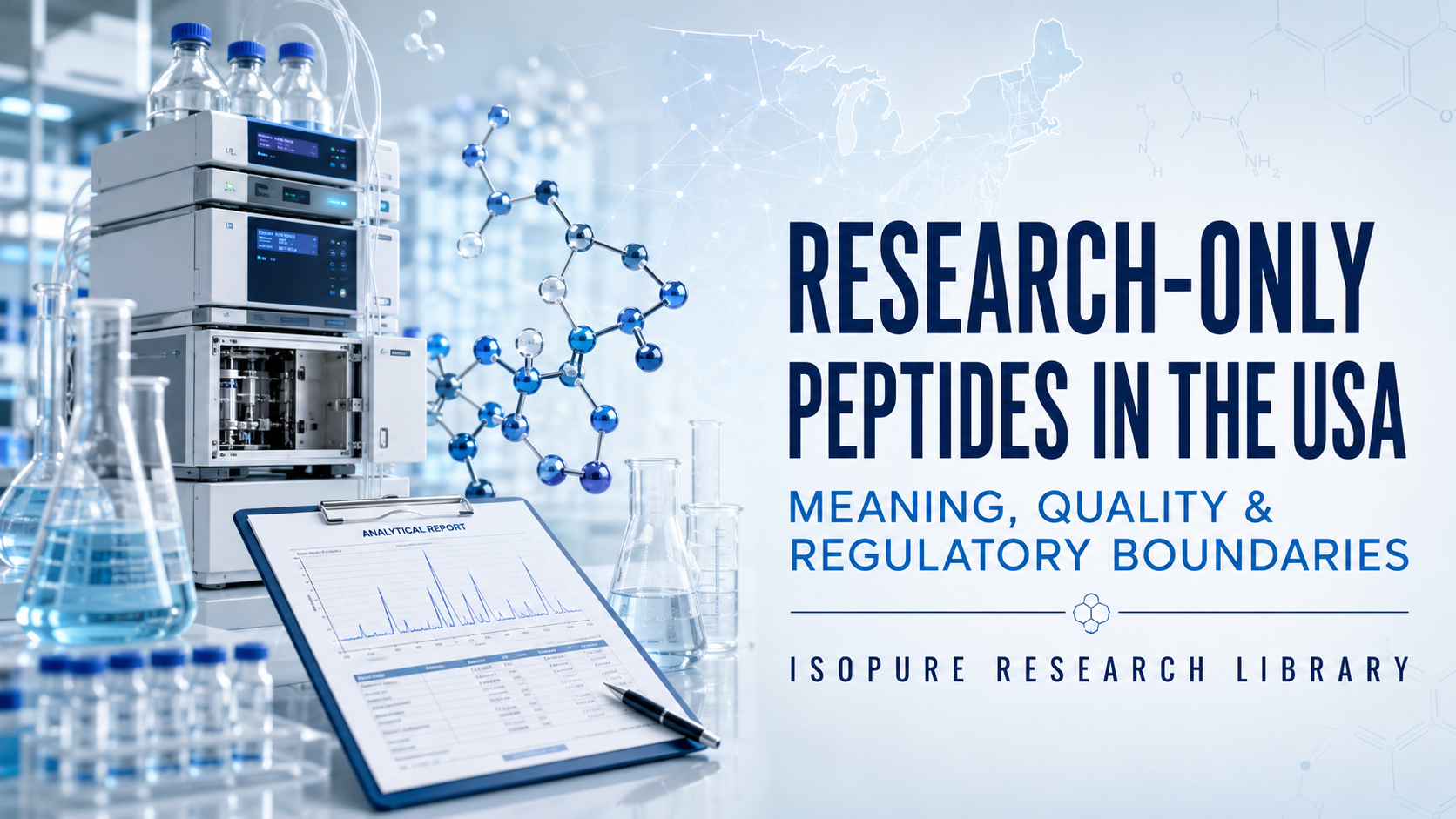
Peptides are studied in the United States across fields such as molecular biology, analytical chemistry, receptor signaling, and pharmaceutical development. However, the phrase “research use only” is frequently misunderstood.
A research-only label does not mean that a peptide has been approved by the U.S. Food and Drug Administration. It also does not make a material appropriate for treatment, self-administration, compounding, or any other human or veterinary use.
Understanding these distinctions helps researchers evaluate materials accurately while avoiding unsupported health and regulatory claims.
What Is a Peptide?
A peptide is a molecule composed of amino acids connected by peptide bonds. Peptides vary considerably in sequence, size, structure, stability, and biological activity.
They may be discussed in several distinct contexts:
- Naturally occurring biological peptides
- FDA-approved peptide-based drug products
- Investigational compounds used in authorized studies
- Reference standards and analytical materials
- Nonclinical laboratory research materials
These categories are not interchangeable. Research involving a peptide does not establish that a commercially available material is an approved medicine or suitable for human use.
What Does “Research-Only” Mean?
In a legitimate laboratory context, research-only peptides are supplied for controlled, nonclinical activities such as:
- Analytical method development
- Chemical identity testing
- Receptor-binding experiments
- Cell-culture research
- Stability and degradation studies
- Assay development
- Reference-material comparisons
“Research-only” should describe the material’s actual intended use—not serve as a disclaimer placed alongside human-use claims.
A research-only peptide should not be marketed with dosing instructions, treatment protocols, personal testimonials, administration guidance, or promises involving weight loss, healing, anti-aging, muscle development, or disease treatment.
A Research Disclaimer Is Not a Regulatory Exemption
The FDA evaluates intended use using the complete context in which a product is offered. This may include:
- Website language
- Product names and descriptions
- Images and promotional graphics
- Blog and social-media claims
- Testimonials
- Customer instructions
- Products packaged or promoted together
- Statements about treating or changing the human body
Consequently, phrases such as “not for human consumption” or “research use only” cannot automatically neutralize conflicting evidence that a material is being promoted for human use.
Recent FDA warning letters involving peptide sellers illustrate that research disclaimers do not protect products that are otherwise marketed as unapproved drugs.
U.S.-Based Does Not Necessarily Mean U.S.-Manufactured
Several different claims are sometimes presented as though they mean the same thing:
- Sold by a company located in the United States
- Shipped from a U.S. warehouse
- Tested by a U.S. laboratory
- Packaged in the United States
- Manufactured or synthesized in the United States
These statements describe different parts of the supply chain. A U.S.-based seller may distribute material manufactured elsewhere, while domestic laboratory testing does not establish domestic synthesis.
“Made in USA” claims should only be used when they can be substantiated under applicable Federal Trade Commission standards.
Researchers should request clear information about manufacturing, testing, packaging, and supply-chain traceability instead of relying on a general “USA peptides” claim.
What Documentation Should Researchers Review?
A responsible evaluation begins with material identity and lot-specific documentation.
Chemical identity
Documentation should identify:
- Peptide name
- Amino-acid sequence
- Molecular formula
- Expected molecular mass
- Salt or counterion form, when applicable
Nicknames and marketing terms are insufficient to establish chemical identity.
Lot-specific Certificate of Analysis
A Certificate of Analysis should correspond to the exact lot supplied. Useful elements include:
- Lot or batch number
- Test date
- Reported analytical methods
- Identity results
- Purity results
- Laboratory information
- Reviewer or approval information
IsoPure’s guide, How to Read a Lot-Specific Certificate of Analysis, explains these elements in greater detail.
Identity testing
Mass spectrometry or another appropriate analytical method may help determine whether the material’s observed molecular characteristics are consistent with the expected compound.
A purity percentage alone does not prove identity.
Chromatographic testing
High-performance liquid chromatography can help characterize chromatographic purity and detect certain related components.
However, HPLC does not independently establish:
- Correct molecular identity
- Biological activity
- Sterility
- Endotoxin status
- Clinical potency
- Safety for human use
For additional context, see HPLC Purity Testing Explained.
Storage and stability information
Peptides can be affected by temperature, moisture, light, oxidation, and repeated handling. Documentation should identify appropriate storage conditions and any available stability limitations.
Why Purity Is Not the Same as Safety
A reported purity result describes the outcome of a particular analytical method under defined test conditions. It does not establish that a material is safe to inject, ingest, or administer.
A high chromatographic purity percentage does not necessarily identify:
- Microbial contamination
- Endotoxins
- Residual solvents
- Incorrect counterions
- Particulate contamination
- Sterility failures
- Degradation occurring after testing
Researchers should interpret every result within the scope and limitations of the method used.
Research Materials and FDA-Approved Medicines Are Different
FDA approval applies to a specific drug product, formulation, manufacturer, labeling, strength, and intended use. It does not extend automatically to every material containing a similar peptide sequence.
Likewise, the fact that a compound has appeared in scientific literature does not make every commercial version safe, effective, or legally marketable for human use.
The distinction between native hormones, receptor agonists, approved medicines, and laboratory materials is discussed further in GLP-1 Terminology Explained.
Health and Benefit Claims Require Evidence
The Federal Trade Commission requires objective health-related advertising claims to be truthful, not misleading, and supported by competent and reliable scientific evidence.
Preclinical findings should not be presented as established human benefits. Results from cells, biochemical assays, or animal models may support further investigation, but they do not independently prove that a product treats a condition or produces a particular outcome in people.
GHK-Cu provides one example of how laboratory findings, cosmetic applications, and proposed human benefits require different levels of evidence.
Research content should clearly distinguish among:
- Proposed mechanisms
- Laboratory observations
- Animal research
- Human clinical evidence
- FDA-authorized indications
Questions a Qualified Research Buyer Should Ask
Before acquiring a peptide for laboratory research, consider asking:
- What is the exact amino-acid sequence?
- What salt or counterion form is supplied?
- Does the Certificate of Analysis match the product lot?
- Which method was used to confirm identity?
- Which method produced the reported purity result?
- Is the testing laboratory identified?
- Where was the material synthesized, tested, and packaged?
- What storage conditions are required?
- Are the limitations of each test clearly stated?
- Is the material restricted to nonclinical laboratory research?
Transparent answers support reproducibility, traceability, and responsible material selection.
Final Perspective
Research-only peptides can serve legitimate purposes in controlled U.S. laboratory environments. Nevertheless, a research label does not establish FDA approval, clinical safety, therapeutic effectiveness, or suitability for administration.
Researchers should evaluate the exact chemical identity, lot-specific documentation, analytical methods, supply-chain information, and intended-use restrictions associated with each material.
IsoPure provides research materials and analytical documentation for qualified laboratory purposes only. Products are not intended for human or veterinary use, diagnosis, treatment, prevention, compounding, or self-administration.
One thought on “Research-Only Peptides in the USA: Meaning, Quality Documentation, and Regulatory Boundaries”