

Blog
GLP-1 Terminology Explained: Native Hormones, Receptor Agonists, and Research Materials

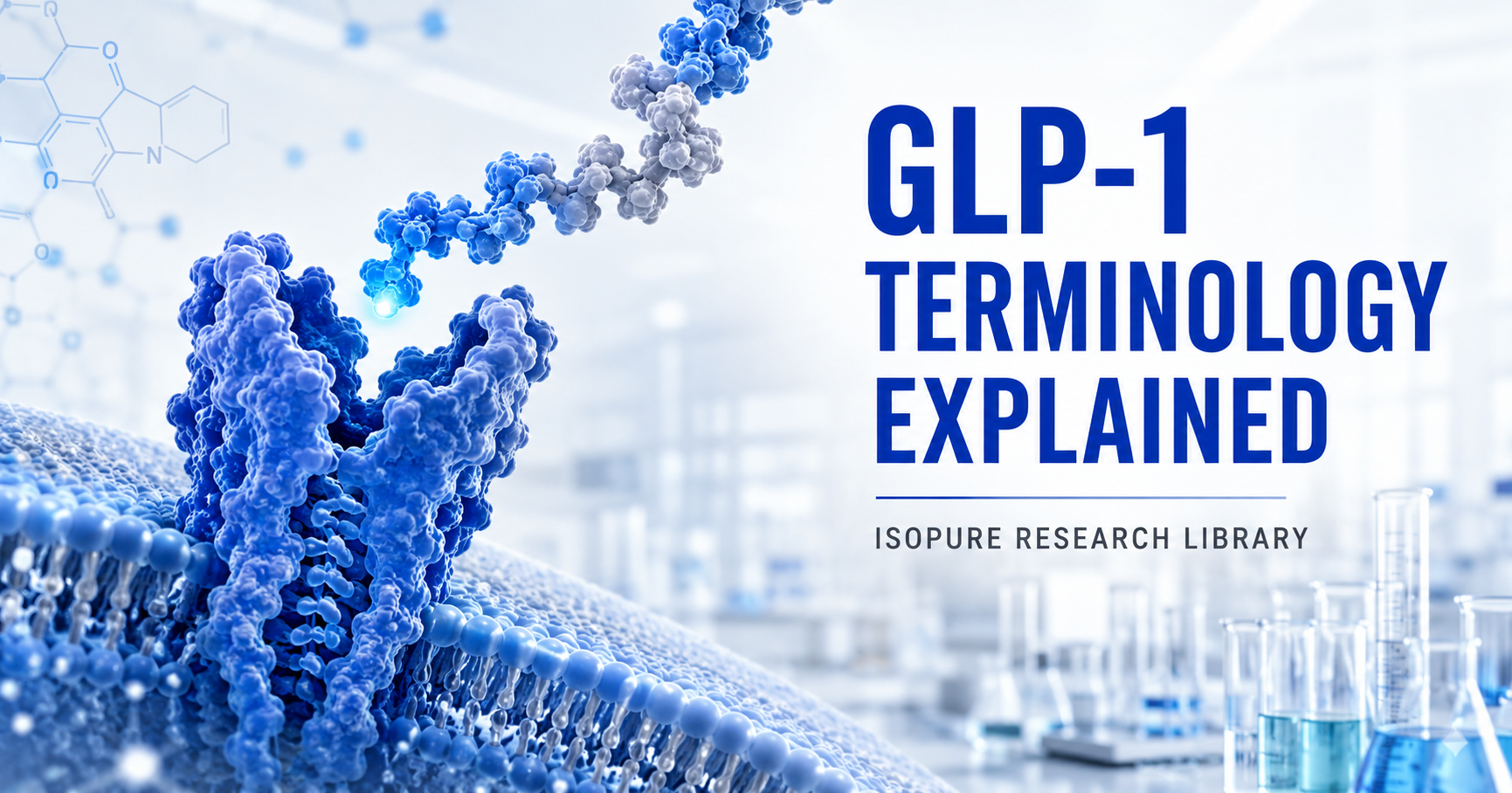
Glucagon-like peptide-1, commonly abbreviated as GLP-1, is discussed in several different scientific, medical, and commercial contexts. The term may refer to a naturally occurring hormone, the receptor through which that hormone signals, a class of FDA-approved medicines, investigational compounds, or nonclinical laboratory research materials.
These categories are related, but they are not interchangeable. Understanding the terminology is essential when reviewing scientific literature, analytical documentation, and product information.
What Is Native GLP-1?
GLP-1 is a naturally occurring peptide hormone released by specialized cells in the intestine following food intake. It participates in the body’s regulation of glucose and digestive signaling.
Native GLP-1 is part of the incretin system. Incretin hormones are released from the gastrointestinal tract and help coordinate biological responses after nutrients are consumed.
Research supported by the National Institute of Diabetes and Digestive and Kidney Diseases contributed to understanding GLP-1’s involvement in glucose-dependent insulin secretion. The natural hormone is broken down relatively quickly in the body and should not be confused with modified pharmaceutical compounds designed to produce longer-lasting receptor activity.
What Is the GLP-1 Receptor?
A receptor is a biological structure that receives and responds to a particular molecular signal. The GLP-1 receptor is found in several tissues and becomes activated when an appropriate molecule binds to it.
Native GLP-1 is one molecule capable of activating this receptor. Scientists study receptor binding, signaling pathways, molecular stability, structure, and biological responses to better understand how the system functions.
The phrase “GLP-1 receptor” describes the biological target. It does not identify a particular product, compound, or regulatory category.
What Is a GLP-1 Receptor Agonist?
An agonist is a substance that binds to and activates a receptor. A GLP-1 receptor agonist is therefore a compound capable of activating the GLP-1 receptor.
Some receptor agonists have been developed and reviewed as prescription medicines. Others may remain investigational or be used only in laboratory research.
The FDA describes approved GLP-1 receptor agonists as medicines that mimic certain effects of the naturally occurring GLP-1 hormone. FDA approval applies only to the specific drug product, formulation, manufacturer, conditions of use, and labeling reviewed by the agency.
The existence of an FDA-approved medicine in a particular class does not make every compound associated with that receptor approved, safe, effective, or legally marketable for human use.
Native Hormones and Modified Compounds Are Not Identical
Native GLP-1 and a modified receptor agonist may interact with the same receptor while differing in important ways.
Possible differences include:
- Amino-acid sequence
- Molecular structure
- Receptor-binding characteristics
- Resistance to enzymatic degradation
- Stability
- Duration of activity
- Formulation
- Manufacturing controls
- Regulatory status
A shared receptor target does not establish that two substances are equivalent or interchangeable.
What Do Single-, Dual-, and Multi-Receptor Terms Mean?
Scientific literature may describe compounds according to the receptors they are designed to activate.
A single-receptor agonist primarily targets one identified receptor system.
A dual-receptor agonist is designed to activate two receptor systems.
A multi-receptor agonist is designed to interact with more than two receptor systems.
These terms describe a proposed or demonstrated mechanism of receptor activity. They do not independently establish safety, effectiveness, approval, purity, identity, or suitability for a particular use.
Researchers should consult the applicable study design, analytical data, reference standards, and regulatory information rather than relying solely on a shortened category name.
FDA-Approved Drugs, Compounded Drugs, Investigational Compounds, and Research Materials
GLP-related terminology may appear across several legally and scientifically different categories.
FDA-approved drug products
An FDA-approved drug has undergone agency review for its labeled conditions of use. Approval is product-specific and does not extend automatically to compounded versions, laboratory materials, or other compounds in the same general class.
Compounded drug products
Compounded drugs are not FDA-approved. According to the FDA, the agency does not review compounded drugs for safety, effectiveness, or quality before they are marketed. Compounding is governed by specific federal and state requirements and should not be confused with FDA approval.
Investigational compounds
An investigational compound is being studied but has not necessarily been approved for commercial medical use. Published research or clinical investigation does not itself establish FDA approval.
Laboratory research materials
A nonclinical research material is represented for legitimate laboratory investigation rather than diagnosis, treatment, prevention, or personal use.
A “research use only” statement does not prove product quality, create FDA approval, or override contradictory marketing and sales practices. The FDA has warned companies that sold unapproved GLP-related products directly to consumers while labeling them “for research purposes” or “not for human consumption.”
Why Exact Terminology Matters
Abbreviations can improve readability, but they can also remove important context. A shortened label such as “GLP” may refer broadly to a hormone system, receptor class, medicine, investigational compound, or laboratory material.
A careful review should identify:
- The complete compound name
- The molecular structure or sequence
- The receptor target or targets
- The intended analytical or research purpose
- Whether the material is approved, investigational, compounded, or nonclinical
- The applicable lot or batch number
- The supporting analytical methods
- The limitations of the available documentation
Alternate terminology should not be used to conceal a compound’s identity or regulatory status.
Identity Testing Versus Purity Testing
Identity and purity answer different analytical questions.
Identity testing evaluates whether a sample is consistent with the compound it is represented to contain.
Purity testing evaluates the relative composition of a sample under the conditions of a particular analytical method.
A high HPLC peak-area percentage does not independently prove identity. Likewise, an identity result does not establish sterility, endotoxin status, exact quantity, safety, effectiveness, or suitability for human use.
The FDA’s Q2(R2) analytical-validation framework treats identity, purity, impurities, assay, and potency as different analytical purposes.
For additional context, read IsoPure’s guide: HPLC Purity Testing Explained: What the Results Mean.
Why Lot-Specific Documentation Matters
Analytical documentation is most useful when it can be connected to the specific production lot being reviewed.
A laboratory report should be examined for:
- Product or sample name
- Lot or batch number
- Laboratory identity
- Sample and report identifiers
- Date received and date tested
- Analytical method
- Identity result
- Purity result
- Chromatogram or supporting data
- Report approval
- Relevant limitations
The lot number shown on the report should correspond with the identifier on the applicable product. A report without a traceable lot number may not demonstrate that its results apply to the material being reviewed.
For a complete review checklist, see How to Read a Lot-Specific Certificate of Analysis.
What Analytical Documentation Does Not Establish
A Certificate of Analysis or laboratory report does not automatically establish:
- FDA approval
- Clinical safety
- Clinical effectiveness
- Suitability for human or animal use
- Sterility, unless specifically tested
- Endotoxin status, unless specifically tested
- Exact quantity, unless an appropriate quantitative assay was performed
- Absence of every possible impurity or contaminant
- Compliance with every manufacturing requirement
Results should be interpreted only within the scope of the tests actually performed.
Questions Researchers Should Ask
When reviewing GLP-related research documentation, consider the following:
- Is the compound identified by its complete name?
- Does the lot number match the applicable material?
- Which method was used to evaluate identity?
- Which method was used to evaluate purity?
- Was an appropriate reference standard used?
- Is the complete chromatogram available?
- Are the laboratory and testing dates identified?
- Were sterility or endotoxin tests actually performed?
- What limitations appear on the report?
- Does the overall presentation remain consistent with nonclinical research use?
These questions help distinguish scientific documentation from unsupported assumptions.
Final Perspective
GLP-1 terminology spans natural biology, receptor science, approved medicines, investigational compounds, compounded products, and nonclinical research materials. Although these subjects may share terminology, their scientific meaning and regulatory status can differ substantially.
Responsible interpretation requires complete compound identification, appropriate analytical methods, lot-specific documentation, clear regulatory distinctions, and an understanding of what each test can—and cannot—demonstrate.
IsoPure provides available lot-specific analytical documentation to support transparency and research-material traceability. Products are offered strictly for laboratory research purposes and are not intended for human or animal use.