
Blog
HPLC Purity Testing Explained: What the Results Mean

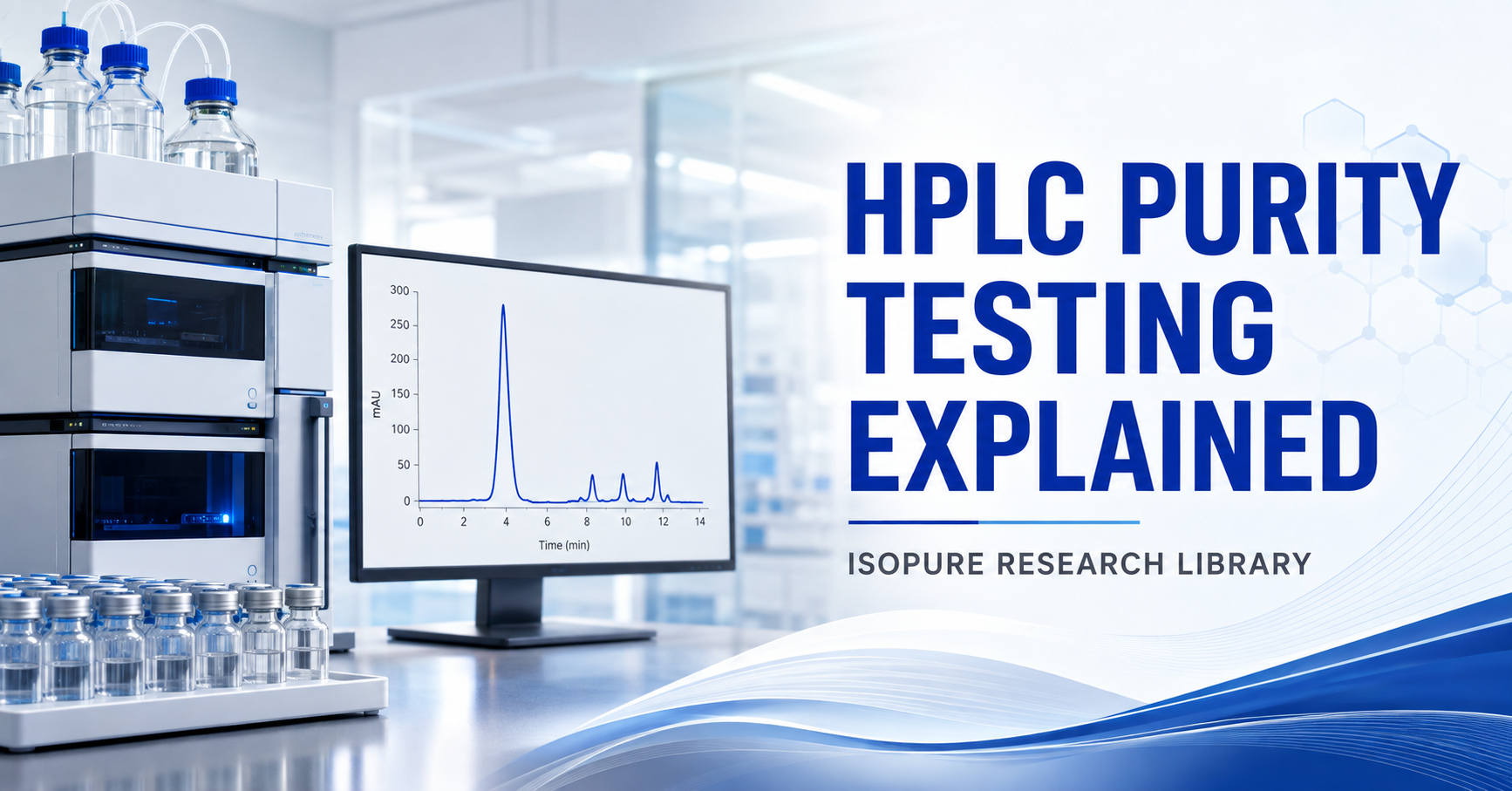
High-performance liquid chromatography, commonly abbreviated as HPLC, is an analytical technique used to separate and detect components within a sample. HPLC reports are frequently included with laboratory research materials because they can provide useful information about chromatographic purity and detected impurities.
However, an HPLC purity percentage should always be interpreted within the scope and limitations of the analytical method. A result such as 98% or 99% does not independently answer every question about a sample.
Sample Solution Purity and HPLC Analysis
In HPLC analysis, the composition and preparation of a sample solution can influence the chromatographic results obtained under a specific method. Purity results should therefore be interpreted alongside the analytical method, sample preparation information, chromatogram, retention data, and other available documentation rather than as an isolated percentage.
How Does HPLC Work?
During HPLC analysis, a prepared sample is introduced into a flowing liquid called the mobile phase. The mobile phase carries the sample through a column containing a stationary phase.
Different components interact differently with the column and therefore travel through it at different rates. As those components leave the column, a detector records a response that can be displayed as a chromatogram.
A chromatogram normally includes:
- Detected peaks
- Retention times
- Peak heights or areas
- Total analysis time
- Information about the detector and method
- A calculated chromatographic purity result
The method, column, mobile phase, detector, sample preparation, and operating conditions can all influence what is separated and detected.
What Is a Chromatogram?
A chromatogram is the graph produced during chromatographic analysis. The horizontal axis generally represents time, while the vertical axis represents the detector response.
Each detected component may produce a peak. The primary component will often produce the largest peak, while smaller peaks may represent impurities, degradation products, related substances, or other detectable components.
A chromatogram should be reviewed together with the written report. A headline percentage alone does not provide enough information to fully evaluate the analysis.
What Does an HPLC Purity Percentage Mean?
An HPLC purity result is commonly calculated by comparing the area of the primary detected peak with the total area of the included detected peaks.
For example, a reported result of 99% may mean that the primary peak represented approximately 99% of the total integrated chromatographic peak area under that particular method.
This is not necessarily the same as stating that 99% of the sample’s total physical mass consists of the intended compound. The result is method-dependent and applies to components the procedure was capable of separating, detecting, and including in its calculations.
The FDA’s analytical-validation framework treats identity, purity, impurities, assay, and potency as distinct analytical uses. This is why a purity result should not be treated as a substitute for every other type of testing.
What Is Retention Time?
Retention time is the amount of time a detected component takes to pass through the chromatographic system and reach the detector.
A retention time may be compared with a qualified reference standard analyzed under the same method. A corresponding retention time can support identification, but retention time alone may not provide conclusive identity confirmation because different substances can sometimes behave similarly.
For stronger characterization, laboratories may combine HPLC with another analytical technique, such as mass spectrometry.
Why Do Smaller Peaks Matter?
Smaller peaks can indicate the presence of additional detectable components. Depending on the sample and method, these may include:
- Related substances
- Synthesis byproducts
- Degradation products
- Sample-preparation artifacts
- Contaminants detectable by the method
- Instrument or integration artifacts
A smaller peak should not automatically be assigned to a particular substance without supporting analytical evidence.
The way a laboratory integrates peaks also affects the reported calculation. Reports should therefore identify the analytical method and provide enough information to understand how the result was produced.
HPLC Purity Versus Identity Testing
HPLC purity testing and identity testing answer different questions.
HPLC purity testing evaluates the relative chromatographic composition of the sample under defined test conditions.
Identity testing evaluates whether the sample is consistent with the compound it is represented to contain.
Mass spectrometry may support identity by evaluating molecular mass. Other techniques may also be used depending on the compound, the analytical objective, and the required degree of certainty.
A large HPLC peak does not, by itself, prove that the peak represents the intended compound. Identity and purity results should be interpreted together when both are available.
How Should a Purity Percentage Be Interpreted?
For this reason, researchers evaluating analytical documentation should consider the purity percentage together with the chromatogram, lot-specific Certificate of Analysis, method information, and complementary analytical results where appropriate.
A reported HPLC purity percentage should be evaluated in the context of the chromatogram and analytical method used to generate the result. Researchers can consider the primary peak, minor detected peaks, retention information, integration parameters, baseline behavior, sample preparation, and testing conditions when reviewing chromatographic data.
A high HPLC area percentage indicates the relative chromatographic response observed under the specified analytical conditions. It should not, by itself, be interpreted as confirmation of molecular identity, exact concentration, sterility, absence of every possible impurity, or suitability for a particular application.
What HPLC Purity Does Not Establish
An HPLC purity result does not automatically establish:
- FDA approval
- Safety or effectiveness
- Suitability for human or animal use
- Sterility
- Endotoxin status
- Exact net quantity
- Total mass purity
- Potency or biological activity
- Residual-solvent content
- Water content
- Absence of every possible contaminant
Each of these characteristics may require a different test or analytical procedure. Whether a component is detected can also depend on the detector, sample preparation, reference materials, sensitivity, and method conditions.
For researchers evaluating freeze-dried materials, our guide to lyophilized peptide reference standards explains how HPLC purity, COAs, lot documentation, and analytical results can be interpreted together.
Why Method Validation Matters
An analytical method should be suitable for its intended purpose. Relevant validation characteristics may include specificity, accuracy, precision, range, detection limit, quantitation limit, and robustness.
Not every characteristic applies identically to every analytical procedure. The required validation work depends on whether the method is intended for identification, purity evaluation, impurity measurement, assay, or another purpose.
A numerical result is more meaningful when the underlying method has been appropriately developed, documented, and evaluated.
Questions to Ask When Reviewing HPLC Results
When reviewing an HPLC report, consider the following:
- Does the sample name match the product being evaluated?
- Does the report include a lot or batch number?
- Does that number match the physical product?
- Is the testing laboratory identified?
- Are the testing and reporting dates shown?
- Is the analytical method identified?
- Is the chromatogram included?
- Are retention times and integrated peaks visible?
- Was a reference standard used?
- Is identity testing reported separately?
- Are the report’s limitations clear?
These details provide more context than a purity percentage presented by itself.
The Importance of Lot-Specific Documentation
Analytical results should be traceable to the specific lot being reviewed. The lot number printed on the product should match the identifier shown on the applicable report.
For a broader explanation of traceability, identity testing, and COA limitations, read IsoPure’s guide: How to Read a Lot-Specific Certificate of Analysis.
Final Perspective
HPLC is a valuable analytical tool, but its results must be interpreted according to the method used and the question the analysis was designed to answer.
A strong review considers the complete chromatogram, method information, lot number, laboratory documentation, identity data, and stated limitations—not simply the largest number shown on the report.
IsoPure provides available lot-specific analytical documentation to support transparency and research-product traceability. Products are offered strictly for laboratory research purposes and are not intended for human or animal use.