

Blog
CJC-1295 vs Ipamorelin: Research Differences, Evidence Limits, and FDA Status

CJC-1295 and ipamorelin are frequently discussed together in online content involving growth-hormone signaling, body composition, recovery, sleep, and athletic performance. Although they are often grouped into the same category, they are chemically distinct compounds that interact with different receptor pathways.
Research into these compounds does not establish that either is safe or effective for bodybuilding, weight loss, anti-aging, injury recovery, or any other unapproved human use. Evidence involving the combination is particularly limited.
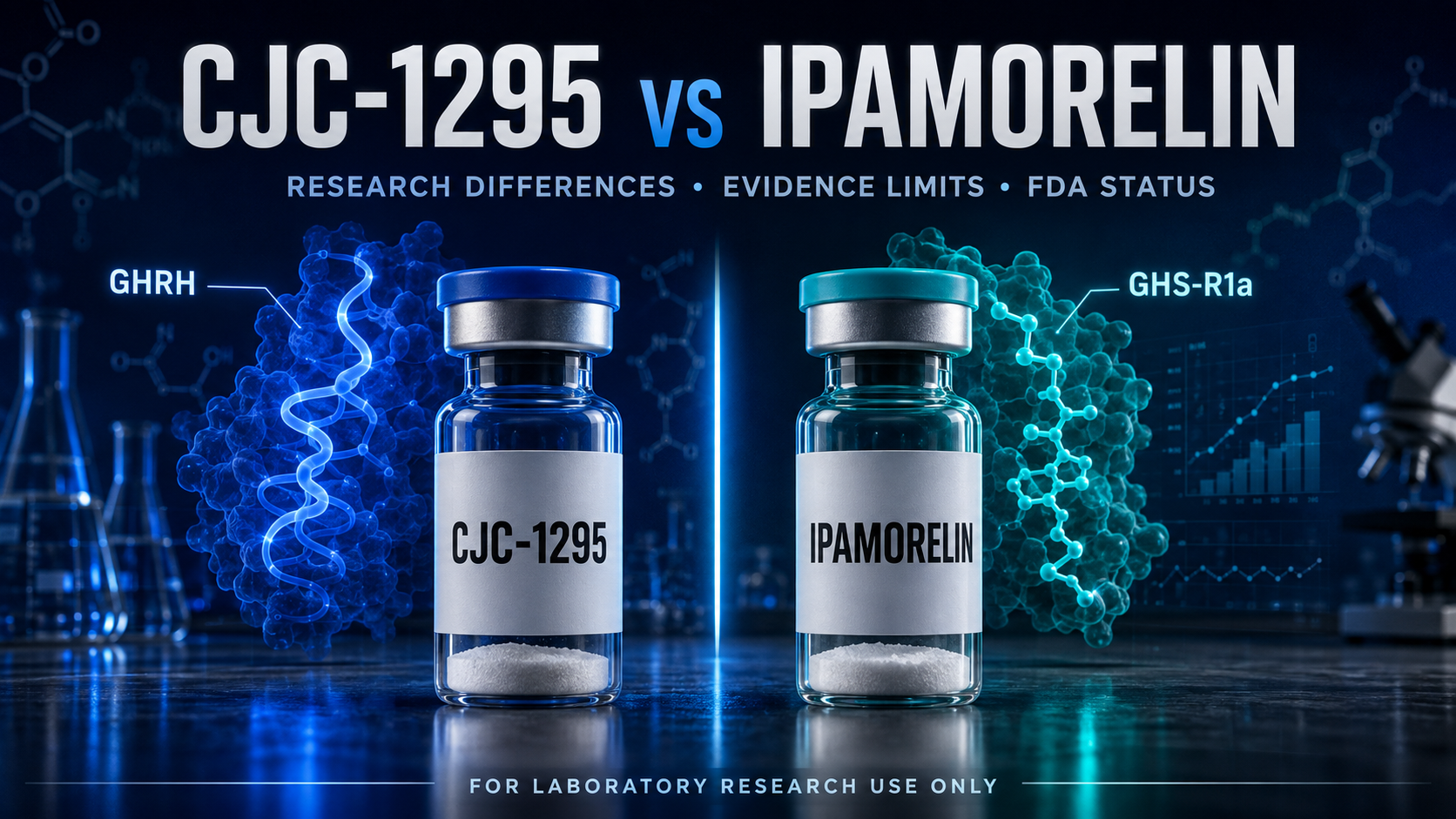
This guide compares CJC-1295 vs ipamorelin from a research perspective, including their proposed mechanisms, analytical differences, evidence limitations, FDA status, and documentation requirements.
Research-use notice: This article is provided exclusively for educational and laboratory research purposes. It does not provide medical advice, dosing information, or instructions for administration. IsoPure research materials are not intended for human or veterinary use, consumption, diagnosis, treatment, or disease prevention.
What Is CJC-1295?
CJC-1295 is a synthetic peptide related to growth hormone-releasing hormone, commonly abbreviated as GHRH.
GHRH is a naturally occurring hypothalamic hormone involved in signaling the pituitary gland. CJC-1295-related materials have been investigated for their interaction with the GHRH receptor and their potential influence on growth-hormone and insulin-like growth factor 1 signaling.
Published human studies from the 2000s evaluated a long-acting CJC-1295-related compound in small groups of healthy adults. Researchers reported changes in growth hormone and IGF-1 measurements, but these early studies did not establish CJC-1295 as an approved treatment or demonstrate long-term safety.
The name “CJC-1295” can also create confusion because it may refer to different chemical forms.
CJC-1295 With DAC vs Without DAC
One of the most important distinctions in CJC-1295 research is whether the material contains a Drug Affinity Complex, or DAC, modification.
The DAC modification was designed to enable binding to circulating albumin and extend the compound’s presence in the body. A material described as “CJC-1295 without DAC” does not have the same modification and should not automatically be treated as chemically or pharmacologically equivalent.
Names encountered in commercial or research settings may include:
- CJC-1295 DAC
- CJC-1295 with DAC
- CJC-1295 without DAC
- Modified GRF 1-29
- CJC-1295 free base
- CJC-1295 acetate
- CJC-1295 DAC acetate
- CJC-1295 DAC trifluoroacetate
These names do not necessarily identify the same substance.
The FDA has specifically discussed inconsistent naming as a characterization and safety concern. A product name by itself may not adequately establish sequence, modification, salt form, molecular mass, or identity.
Researchers should verify the exact compound rather than assuming every vial labeled “CJC-1295” contains the same material.
What Is Ipamorelin?
Ipamorelin is a synthetic pentapeptide studied as a growth-hormone secretagogue.
Unlike CJC-1295-related materials, ipamorelin is not a GHRH analog. It has been investigated as an agonist of the growth hormone secretagogue receptor, also called the ghrelin receptor or GHS-R1a.
Early research described ipamorelin as relatively selective for growth-hormone release compared with some older growth-hormone-releasing peptides. Selectivity observed under experimental conditions does not establish clinical safety or prove that other biological effects cannot occur.
Ipamorelin has been studied in laboratory, animal, healthy-volunteer, and limited clinical-development settings. These studies did not result in FDA approval.
CJC-1295 vs Ipamorelin: What Is the Main Difference?
The primary research distinction is the receptor pathway associated with each compound:
| Research characteristic | CJC-1295-related material | Ipamorelin |
|---|---|---|
| General classification | GHRH-related analog | Growth-hormone secretagogue |
| Principal research pathway | GHRH receptor | Ghrelin/GHS-R1a receptor |
| Structure | Longer peptide; form varies | Synthetic pentapeptide |
| Major naming issue | DAC, non-DAC, free-base and salt distinctions | Free-base and acetate distinctions |
| FDA-approved drug | No | No |
| Combination approval | None | None |
| Long-term human evidence | Limited | Limited |
| Bodybuilding or anti-aging approval | None | None |
This difference is why the compounds are sometimes examined as complementary research signals. Mechanistic complementarity does not prove that combining them is safe, effective, or clinically appropriate.
Do CJC-1295 and Ipamorelin Work Through the Same Receptor?
No. They are studied in connection with different receptor systems.
CJC-1295-related compounds are associated with the GHRH receptor. Ipamorelin is associated with the growth hormone secretagogue receptor.
Both pathways can influence growth-hormone signaling, but approaching the same downstream hormone through different receptors does not make the compounds interchangeable.
The distinction can affect:
- Receptor binding
- Signaling patterns
- Pharmacokinetics
- Duration of measured effects
- Potential off-target effects
- Analytical identification
- Experimental design
Researchers should record the exact material, chemical form, sequence, and study conditions when interpreting findings.
Why Are CJC-1295 and Ipamorelin Frequently Discussed Together?
Online articles commonly describe the compounds as a “stack” because they are associated with different signaling pathways that may converge on growth-hormone release.
However, a popular combination name is not a recognized clinical indication or proof of a validated formulation.
Claims about combining the two often rely on:
- Mechanistic assumptions
- Findings from each compound studied separately
- Anecdotal reports
- Extrapolation from other secretagogues
- Uncontrolled observations
- Marketing material
Evidence about one compound cannot automatically be applied to a combination. Combining two biologically active materials can change exposure, response, and risk.
A scientifically valid evaluation of a combination would require studies designed specifically for that combination.
Has the CJC-1295 and Ipamorelin Combination Been Clinically Proven?
There is insufficient high-quality evidence to conclude that the CJC-1295 and ipamorelin combination is clinically proven for bodybuilding, fat loss, muscle gain, recovery, sleep, anti-aging, or general wellness.
Separate studies of each compound do not establish the safety or effectiveness of using them together.
Important unanswered questions include:
- The interaction between their signaling pathways
- Appropriate exposure levels
- Short- and long-term safety
- Potential effects on glucose regulation
- Effects of prolonged IGF-1 elevation
- Immunogenicity
- Product aggregation
- Drug interactions
- Risk in people with underlying conditions
- Long-term pituitary effects
Without controlled combination trials, claims of synergy remain unconfirmed.
What Does CJC-1295 Research Show?
Small early studies evaluated the pharmacokinetic and pharmacodynamic behavior of a long-acting CJC-1295-related compound in healthy adults.
Researchers reported sustained increases in measured growth hormone and IGF-1 after administration. Another published analysis reported that pulsatile growth-hormone secretion was preserved while basal growth-hormone levels increased.
These studies help explain why CJC-1295 is scientifically interesting. They do not prove that it:
- Builds muscle
- Reduces body fat
- Improves sleep
- Repairs injuries
- Reverses aging
- Enhances athletic performance
- Is safe for repeated long-term use
The FDA has noted limitations including small study populations, uncertainty about the exact substance studied, and limited clinical safety information.
What Does Ipamorelin Research Show?
Early studies investigated ipamorelin’s receptor activity and its ability to stimulate growth-hormone release.
A pharmacokinetic and pharmacodynamic study evaluated different infusion levels in healthy male volunteers. Other development programs examined ipamorelin for postoperative gastrointestinal recovery rather than bodybuilding, anti-aging, or general wellness.
A randomized proof-of-concept study involving postoperative ileus did not establish ipamorelin as an FDA-approved treatment.
The FDA has identified gaps involving effectiveness, long-term safety, characterization, and clinical evidence for proposed compounded uses.
Findings that ipamorelin can affect a hormone measurement do not prove meaningful or beneficial clinical outcomes.
Does Either Compound Increase Muscle or Reduce Fat?
Neither CJC-1295 nor ipamorelin is FDA approved for increasing muscle, reducing body fat, improving athletic performance, or changing body composition.
Hormonal signaling findings are not the same as proven changes in health or performance.
To establish a body-composition benefit, controlled studies would need to evaluate outcomes such as:
- Changes in fat mass
- Changes in lean mass
- Strength or performance measurements
- Clinical relevance
- Durability of the effect
- Adverse events
- Long-term risks
A change in growth hormone or IGF-1 alone does not answer those questions.
Do CJC-1295 or Ipamorelin Improve Sleep?
Online content frequently associates growth-hormone secretagogues with deeper or better sleep.
The available evidence does not establish CJC-1295 or ipamorelin as approved sleep treatments. Hormone-release patterns during sleep do not prove that increasing or modifying those signals improves sleep quality or treats a sleep disorder.
Sleep-related claims would require controlled studies using validated outcomes such as:
- Sleep duration
- Sleep efficiency
- Polysomnography
- Daytime functioning
- Adverse effects
- Comparisons with placebo
Mechanistic speculation should not be presented as a demonstrated benefit.
Are CJC-1295 and Ipamorelin FDA Approved?
No. CJC-1295 and ipamorelin are not FDA-approved drugs.
The FDA has separately reviewed CJC-1295-related and ipamorelin-related bulk drug substances in connection with compounding policy. Review or nomination for a compounding list is not the same as drug approval.
FDA approval applies to a specific drug product with reviewed evidence concerning:
- Identity and formulation
- Manufacturing controls
- Safety
- Effectiveness
- Labeling
- Indication
- Dosage form
- Benefit-risk profile
Neither compound has received that approval.
The combination of CJC-1295 and ipamorelin is also not FDA approved.
What Concerns Has the FDA Identified About CJC-1295?
The FDA has identified several concerns involving CJC-1295-related materials, including:
- Limited clinical data
- Potential immunogenicity
- Peptide aggregation
- Peptide-related impurities
- Inconsistent naming
- Uncertain chemical identity
- Serious adverse events involving increased heart rate
- Systemic vasodilatory reactions
- Limited long-term safety information
The agency has also discussed nonclinical safety signals and uncertainties involving prolonged stimulation of the growth-hormone axis.
A claim that CJC-1295 is “safe because it is a peptide” is not supported.
What Concerns Has the FDA Identified About Ipamorelin?
FDA materials discuss concerns involving:
- Limited evidence of effectiveness
- Potential immunogenicity
- Aggregation
- Peptide-related impurities
- Unnatural amino acids
- Characterization complexity
- Insufficient long-term safety evidence
- Serious events observed during clinical development
The FDA has noted that serious adverse events, including deaths, occurred among ipamorelin-treated subjects in a study involving postoperative patients. The agency also stated that it was unclear whether those deaths were caused by ipamorelin.
That uncertainty should be represented accurately. It does not prove causation, but it also does not support claims of established safety.
Does “Selective” Mean Ipamorelin Is Risk-Free?
No. Selectivity describes how a compound interacts with certain biological targets under specified experimental conditions.
It does not mean:
- No adverse effects
- No off-target activity
- No drug interactions
- No immunogenicity
- No product impurities
- No long-term risks
- Proven safety for administration
- Suitability for every research model
Marketing content should not translate “selective” into “safe” or “side-effect free.”
Why Analytical Identity Is Especially Important
CJC-1295-related materials can present unusual identity and naming problems because DAC and non-DAC forms are not equivalent.
Researchers should verify:
- Full amino-acid sequence
- Presence or absence of the DAC modification
- Free-base or salt form
- Expected molecular formula
- Expected molecular mass
- Observed molecular mass
- Lot number
- Analytical method
- Date of analysis
- Storage conditions
For ipamorelin, documentation should similarly distinguish the free base from ipamorelin acetate and identify the appropriate molecular characteristics.
An abbreviated vial label alone may not provide enough information to establish identity.
How Should Researchers Evaluate a COA?
A Certificate of Analysis should correspond to the exact production lot being reviewed.
Useful documentation may include:
- Matching lot number
- Compound name and form
- Test date
- HPLC chromatogram
- Reported chromatographic purity
- Mass-spectrometry results
- Expected and observed mass
- Laboratory identification
- Review or approval information
HPLC puhttps://isopurepep.com/2026/08/29/hplc-purity-testing-explained/rity and mass-spectrometry identity provide complementary information. Neither independently establishes sterility, endotoxin status, biological activity, clinical safety, or FDA approval.
A generic COA should not be treated as evidence for every vial or production lot.
Common Claim Problems
Content should avoid presenting the following as established facts:
- “Builds lean muscle”
- “Burns belly fat”
- “Improves deep sleep”
- “Repairs injuries”
- “Restores youthful hormone levels”
- “Reverses aging”
- “Has no side effects”
- “Safe because it preserves natural pulses”
- “Clinically proven stack”
- “FDA compliant for human use”
More accurate language includes:
- “Studied in growth-hormone signaling research”
- “Associated with different receptor pathways”
- “Human evidence remains limited”
- “Long-term safety has not been established”
- “The combination lacks adequate controlled trials”
- “Not approved for bodybuilding or anti-aging”
Frequently Asked Questions
Is CJC-1295 the same as ipamorelin?
No. CJC-1295-related materials are associated with the GHRH receptor, while ipamorelin is associated with the ghrelin or growth hormone secretagogue receptor.
What does DAC mean in CJC-1295?
DAC means Drug Affinity Complex. The modification was designed to enable albumin binding and extend exposure. DAC and non-DAC materials should not be treated as identical.
Is CJC-1295 without DAC the same as modified GRF 1-29?
The names are often used interchangeably in commercial settings, but naming can be inconsistent. Researchers should confirm the actual sequence, modification, form, and molecular mass rather than relying on a common name.
Are CJC-1295 and ipamorelin FDA approved?
No. Neither compound nor their combination is an FDA-approved drug.
Is the combination clinically proven?
No. Evidence from compounds studied separately does not establish the safety or effectiveness of their combination.
Does ipamorelin have no effect on cortisol or prolactin?
Early experimental research described relative selectivity under particular study conditions. That does not prove the absence of such effects under every exposure level, formulation, population, or combination.
Does a high purity result prove the compounds are safe?
No. Analytical purity does not independently establish identity, sterility, endotoxin status, immunogenicity, clinical safety, or effectiveness.
Can these research materials be used for bodybuilding?
Research materials labeled exclusively for laboratory use are not intended for bodybuilding, personal use, consumption, or self-administration.
Final Perspective
CJC-1295 and ipamorelin are different research compounds that interact with separate receptor pathways associated with growth-hormone signaling.
Their mechanistic differences explain the scientific interest in comparing them. Those differences do not demonstrate that combining them produces a safe or effective clinical result.
The most accurate conclusions are:
- CJC-1295 and ipamorelin are not interchangeable
- CJC-1295 naming and DAC status require careful verification
- Separate studies do not validate the combination
- Human evidence and long-term safety data remain limited
- Neither compound is FDA approved
- Analytical testing does not convert research material into approved medicine
Responsible content should clearly distinguish experimental mechanisms from proven human outcomes.
Research-use disclaimer: IsoPure products and educational materials are intended exclusively for qualified laboratory research. Products are not intended for human or veterinary use, consumption, compounding, diagnosis, treatment, mitigation, bodybuilding, anti-aging, or prevention of disease. Nothing in this article constitutes medical advice.
References
- FDA: Certain Bulk Drug Substances for Use in Compounding That May Present Significant Safety Risks
- FDA: CJC-1295-Related Bulk Drug Substances Briefing Materials
- FDA: Ipamorelin-Related Bulk Drug Substances Briefing Materials
- Teichman S.L. et al.: Prolonged stimulation of growth hormone and IGF-1 by CJC-1295
- Ionescu M. and Frohman L.A.: Pulsatile secretion of growth hormone persists during continuous stimulation by CJC-1295
- Raun K. et al.: Ipamorelin, the first selective growth hormone secretagogue
- Gobburu J.V. et al.: Pharmacokinetic-pharmacodynamic modeling of ipamorelin in healthy volunteers