

Blog
How to Spot a Fake Peptide COA: 10 Research Supplier Red Flags

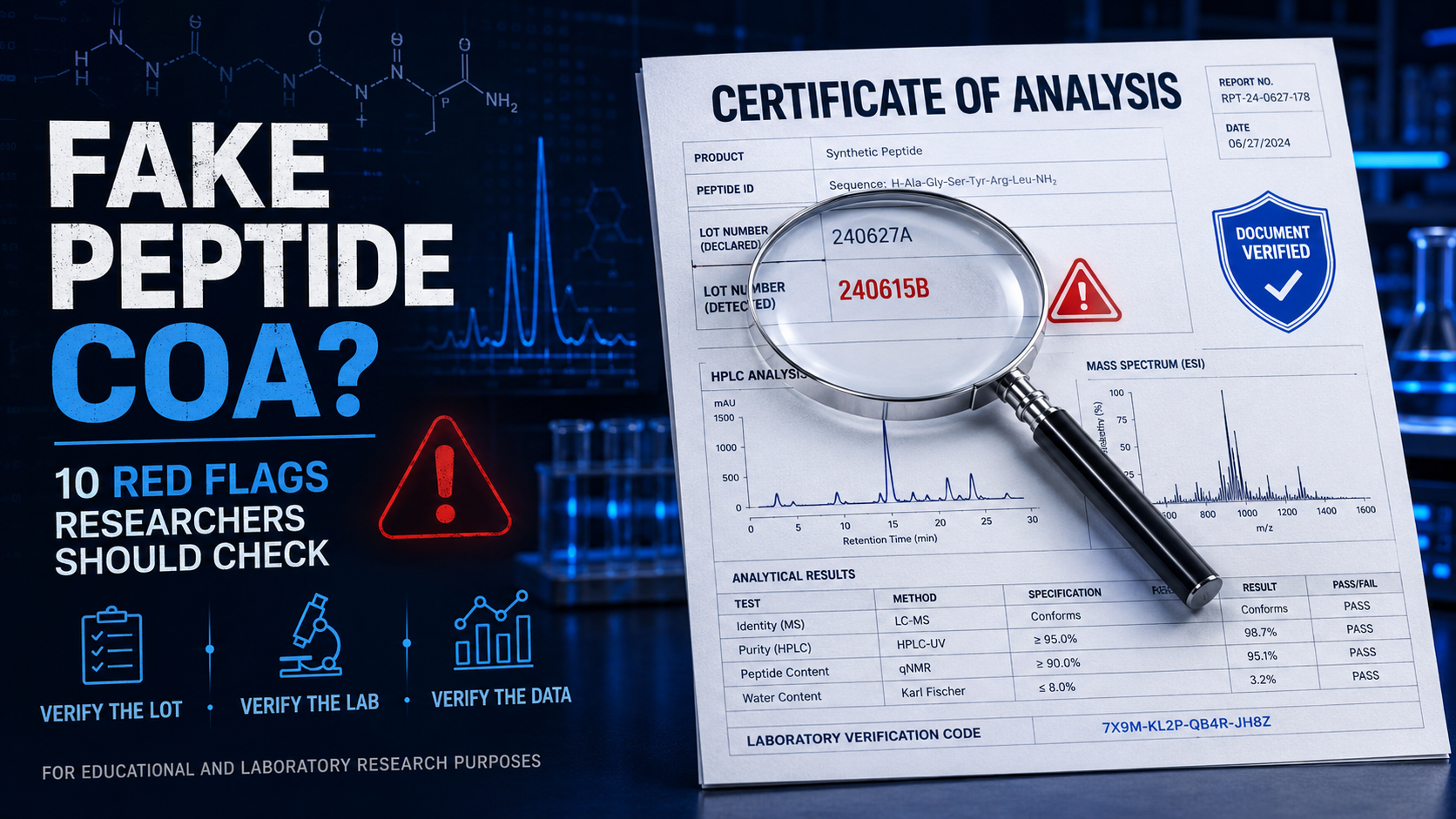
A Certificate of Analysis, commonly called a COA, can provide valuable information about the identity and purity of a research material. Unfortunately, a polished PDF does not automatically prove that testing occurred, that the issuing laboratory is legitimate, or that the report applies to the vial being evaluated.
Certificates can be outdated, incomplete, reused across multiple batches, altered, issued for a different product, or presented with claims that exceed what the analytical methods establish.
Researchers should evaluate the document, the issuing laboratory, the lot number, and the underlying analytical results before relying on a COA.
This guide explains how to spot a potentially fake or misleading peptide COA, how to verify research-supplier documentation, and what common quality claims can—and cannot—prove.
Research-use notice: This article is provided exclusively for educational and laboratory research purposes. It does not provide medical advice or establish that any material is suitable for human or veterinary use. IsoPure research materials are not intended for consumption, compounding, diagnosis, treatment, or administration.
What Is a Peptide Certificate of Analysis?
A peptide Certificate of Analysis is a laboratory document reporting analytical findings associated with a sample or production lot.
Depending on the testing performed, a COA may include:
- Compound name
- Sample or lot number
- Date of analysis
- HPLC purity
- HPLC chromatogram
- Expected molecular mass
- Observed molecular mass
- Mass-spectrometry data
- Testing methods
- Laboratory name
- Report or verification number
- Analyst or reviewer information
The presence of these fields does not automatically make a document authentic. Researchers should confirm that the information is internally consistent and traceable to the issuing laboratory.
What Does a COA Actually Prove?
A legitimate COA supports only the tests and sample identified in the report.
For example:
- HPLC may provide information about chromatographic purity
- Mass spectrometry may help confirm molecular identity
- Quantitative testing may estimate peptide content
- Endotoxin testing may report endotoxin findings
- Microbial or sterility testing may address separate quality attributes
One result should not be used to claim that unrelated tests were passed.
A COA reporting 99% HPLC purity does not independently establish:
- Correct identity
- Quantity in the vial
- Sterility
- Endotoxin status
- Absence of heavy metals
- Clinical safety
- Biological effectiveness
- FDA approval
- Suitability for administration
A document becomes misleading when its results are presented as proof of attributes that were never tested.
Red Flag 1: The Lot Number Does Not Match
The lot or batch number is one of the most important connections between a COA and the physical material.
Compare the lot number on:
- The vial
- The COA
- The supplier’s product or testing page
- The order record
- Any laboratory verification page
If the numbers do not match, the report does not document that specific lot.
A COA for an older or different batch may still be a real report, but it cannot establish the findings for the vial being evaluated.
The absence of a matching lot number does not prove fraud by itself. It does mean the document lacks the traceability required to connect its results to the material.
Red Flag 2: The Testing Laboratory Is Not Identified
A COA without a laboratory name is difficult or impossible to verify.
A useful report should normally identify the organization that performed the analysis. Researchers should independently search for the laboratory rather than relying only on links supplied by the vendor.
Check whether the laboratory has:
- A functioning official website
- Verifiable contact information
- A physical or registered business presence
- Information about its analytical capabilities
- A method for confirming reports
- Relevant accreditation information, when claimed
A laboratory logo alone is not enough. Logos, signatures, addresses, and document templates can be copied.
Red Flag 3: The Report Cannot Be Verified With the Laboratory
Many testing laboratories assign a report number, sample number, accession code, or digital verification identifier.
Use the laboratory’s independently located website or contact information to verify the document.
Ask the laboratory to confirm:
- Whether it issued the report
- Whether the report number is valid
- The sample name submitted
- The date of analysis
- Whether the displayed results match its records
- Whether the document has been modified
Do not rely exclusively on a verification link embedded in the vendor’s PDF. A deceptive document could direct researchers to an imitation website.
Finding and contacting the laboratory independently is a stronger verification method.
Red Flag 4: The COA Is Generic or Reused
A report titled “sample COA,” “typical analysis,” or “representative result” does not establish the quality of a current production lot.
Generic COAs may be useful for showing what a document format looks like, but they should not be presented as batch-specific evidence.
Watch for:
- The same report used for every product strength
- The same lot number displayed across unrelated compounds
- A report that remains unchanged for years
- No lot number on the vial
- No test date
- No connection between the tested sample and the current inventory
Testing one historical sample does not prove that every later batch has identical identity, purity, or content.
Red Flag 5: The Compound Name and Molecular Data Conflict
The compound name, expected molecular mass, molecular formula, sequence, and observed mass should be logically consistent.
Potential concerns include:
- A mass result associated with a different peptide
- A sequence that does not match the named compound
- A free-base result presented for an acetate form without explanation
- A DAC form confused with a non-DAC form
- Different compound names on different pages
- A product strength or form not represented by the report
Researchers may need to consult recognized chemical databases or technical literature to determine whether the reported values are plausible.
Small formatting differences are not automatically evidence of fraud. Substantive chemical contradictions require clarification.
Red Flag 6: The COA Reports Purity but Not Identity
HPLC and mass spectrometry answer different analytical questions.
HPLC can separate detectable components and estimate the relative area associated with the principal chromatographic peak. It does not, by itself, prove that the principal peak is the intended peptide.
Mass spectrometry measures mass-to-charge information and can help determine whether the detected material is consistent with the expected molecular mass.
A material could theoretically produce a high-purity chromatographic result while still being the wrong compound.
A purity percentage without meaningful identity information is incomplete evidence. It should not be described as full confirmation of the product.
Red Flag 7: There Is a Purity Number but No Supporting Data
A COA may display a purity result such as 99.2%, but researchers should determine how that number was obtained.
Supporting information may include:
- Analytical method
- HPLC chromatogram
- Peak-integration table
- Retention-time information
- Detector details
- Column or method information
- Sample identifier
- Review or approval record
Not every legitimate laboratory uses the same report format, and some laboratories provide supporting files separately. Therefore, the absence of a chromatogram does not automatically prove that a COA is fake.
It does mean researchers should request the supporting analytical record and verify what the reported percentage represents.
Red Flag 8: Dates Are Missing or Illogical
Review every date appearing on the report.
Potential problems include:
- A test date occurring before the batch was reportedly manufactured
- A future test date
- A report issued long before the supplier existed
- Conflicting dates across pages
- No analysis date
- A reused report that does not correspond to current inventory
Dates should also be considered alongside storage history and stability documentation. A real historical analysis does not necessarily establish the current condition of material after prolonged or improper storage.
Red Flag 9: The Document Contains Internal Inconsistencies
Fake or altered reports may contain details copied from multiple sources.
Look for:
- Different fonts within data fields
- Misaligned numbers
- Blurry text placed over sharp text
- Inconsistent laboratory names
- A logo that differs from the lab’s official branding
- Duplicate report numbers
- Different product names on separate pages
- Units that change without explanation
- Missing page numbers
- Spelling errors in technical terms
- Purity values that do not match the peak table
Visual irregularities are warning signs, not conclusive proof. Legitimate laboratories can produce imperfectly formatted reports.
The strongest evidence comes from verifying the report directly with the named laboratory.
Red Flag 10: The Supplier Makes Claims the COA Cannot Support
A COA may be authentic while the supplier’s interpretation is misleading.
Be cautious when analytical results are presented as proof that a research material is:
- FDA approved
- Pharmaceutical grade
- Clinically proven
- Safe for humans
- Sterile
- Free from endotoxins
- Effective for weight loss
- Appropriate for injection
- Equivalent to an approved medicine
- Guaranteed to produce a biological outcome
Testing for identity or chromatographic purity does not establish those claims.
A responsible supplier explains the boundaries of each test rather than turning a laboratory result into a medical or regulatory endorsement.
How to Verify a Peptide COA Step by Step
Use this process when reviewing research-material documentation:
Step 1: Match the lot number
Confirm that the lot number on the vial matches the COA exactly.
Step 2: Identify the laboratory
Locate the laboratory’s official website and contact information independently.
Step 3: Verify the report number
Use the laboratory’s verification portal or contact the laboratory directly.
Step 4: Confirm the compound
Compare the compound name, sequence, form, and molecular data.
Step 5: Review the methods
Determine whether the report includes both purity and identity testing.
Step 6: Examine the dates
Confirm that the analysis date and batch information are logically consistent.
Step 7: Request supporting data
Ask for chromatograms, spectra, integration tables, or related files when appropriate.
Step 8: Check the claimed scope
Make sure the supplier is not claiming more than the testing demonstrates.
Step 9: Preserve the records
Save the COA, product photographs, order information, and verification correspondence.
Step 10: Resolve inconsistencies before research use
If the document cannot be verified or contains unexplained contradictions, request clarification before incorporating the material into an experiment.
Does Third-Party Testing Guarantee Quality?
No. “Third-party tested” is not a complete description.
Researchers should ask:
- Which laboratory performed the test?
- Who selected and submitted the sample?
- Was the sample taken from the same lot?
- Which methods were performed?
- Can the report be independently verified?
- Does the laboratory have relevant competence or accreditation?
- Are supporting records available?
- Was the sample supplied directly by the vendor?
Third-party testing can reduce some conflicts of interest, but it does not guarantee that the tested sample represents every vial in a batch.
Transparency about sampling and chain of custody strengthens the value of the results.
What Does ISO/IEC 17025 Mean?
ISO/IEC 17025 establishes general competency requirements for testing and calibration laboratories.
Accreditation may provide evidence that an independent body assessed a laboratory’s competence for activities within a defined scope.
However, researchers should verify:
- Which organization granted the accreditation
- Whether the accreditation is current
- The laboratory’s accredited scope
- Whether the specific analytical method is covered
- Whether the named facility is the accredited location
A laboratory being accredited for one type of test does not automatically mean every service it offers falls within that accredited scope.
Claims of accreditation should be checked with the relevant accreditation body.
HPLC Purity vs Net Peptide Content
HPLC purity is commonly misunderstood as the percentage of the vial that consists of active peptide.
These are different measurements.
HPLC purity generally describes the relative proportion of the target chromatographic peak compared with other detected peptide-related peaks under the test conditions.
Net peptide content addresses how much of the total material consists of the peptide itself after accounting for factors such as:
- Water
- Counterions
- Residual solvents
- Salts
- Other non-peptide material
A sample may have high chromatographic purity while its net peptide content is lower.
A COA should not use HPLC purity as a substitute for a quantitative content assay.
Does a COA Prove Sterility?
No, unless appropriate sterility testing was separately performed and reported.
HPLC and mass spectrometry do not establish sterility.
Sterility, microbial limits, bacterial endotoxins, heavy metals, and residual solvents require separate methods. The absence of a reported contaminant result does not prove that the contaminant is absent.
Researchers should review only the tests actually documented.
Can You Verify a Peptide by Its Appearance?
No. Color, powder volume, cake shape, vial size, label quality, and packaging cannot establish molecular identity or purity.
A professional label can be placed on the wrong material. An authentic compound can also vary in appearance depending on formulation, fill volume, residual moisture, and lyophilization conditions.
Appearance may reveal obvious packaging problems, but analytical testing is required for meaningful identity and purity conclusions.
Research Supplier Website Red Flags
Documentation should be considered alongside the supplier’s overall transparency.
Possible warning signs include:
- No accessible COA library
- No lot-specific documentation
- An anonymous testing laboratory
- Reports that cannot be verified
- Contradictory product names
- Medical claims attached to research materials
- Dosing or injection instructions
- Before-and-after photographs
- Claims of FDA approval without an approved product
- No research-use policy
- No contact or return information
- Pressure to pay through irreversible methods
- Fake or undisclosed reviews
No single website feature proves fraud. Multiple unresolved inconsistencies should increase scrutiny.
What Should You Do If a COA Appears Fake?
If a report appears altered, fabricated, or unrelated to the supplied lot:
- Preserve the original PDF and webpage.
- Photograph the vial, label, lot number, and packaging.
- Save receipts and communications.
- Contact the named laboratory independently.
- Request written confirmation of the report’s status.
- Ask the supplier for an explanation.
- Avoid relying on the disputed document for research decisions.
- Contact the payment provider if the merchandise was materially misrepresented.
- Report suspected fraud to the appropriate platform or authority.
The Federal Trade Commission accepts reports concerning fraud, scams, and deceptive business practices at ReportFraud.ftc.gov.
Avoid making public accusations before confirming the facts. A mismatched or incomplete document may result from administrative error rather than intentional fabrication.
ReportFraud.ftc.gov
Frequently Asked Questions
What is the biggest sign of a fake peptide COA?
The strongest concern is a report that the named laboratory says it did not issue. A mismatched lot number is also a major traceability failure.
Can a real COA be misleading?
Yes. A genuine report can be presented for the wrong batch, reused after inventory changes, or interpreted as proving attributes that were never tested.
Should the COA lot number match the vial?
Yes. Without a matching lot identifier, the report is not directly tied to that vial’s production lot.
Does HPLC confirm peptide identity?
Not by itself. HPLC primarily provides chromatographic-separation and purity information. Mass spectrometry can provide complementary identity information.
Does mass spectrometry prove purity?
Not by itself. Identity and chromatographic purity are separate analytical questions.
Is a 99% purity result enough?
No. It does not independently establish identity, net peptide content, sterility, endotoxin status, safety, or FDA approval.
Is an anonymous COA trustworthy?
An anonymous report is difficult to verify because researchers cannot confirm who performed the testing or whether the document is authentic.
Does third-party testing mean every vial was tested?
No. Testing normally evaluates the submitted sample. Researchers should determine how that sample relates to the documented production lot.
Does ISO accreditation guarantee the result?
No accreditation can guarantee every result. It can support laboratory competence within a defined scope, which should be independently verified.
Can a COA prove a peptide is safe for human use?
No. A research-material COA does not establish clinical safety or suitability for administration.
Final Research Checklist
Before relying on a peptide COA, confirm:
- The vial and report lot numbers match
- The laboratory exists
- The report can be verified independently
- The compound name and molecular data agree
- The analysis date is plausible
- Purity and identity are distinguished
- Supporting analytical information is available
- Accreditation claims can be confirmed
- The supplier does not overstate the results
- The documentation applies to the actual research lot
A COA should function as a traceable analytical record—not as a decorative marketing certificate.
Research-use disclaimer: IsoPure products and educational materials are intended exclusively for qualified laboratory research. Products are not intended for human or veterinary use, consumption, compounding, diagnosis, treatment, mitigation, or prevention of disease. Nothing in this article constitutes medical advice.
References
- NIST: Laboratory Standard ISO/IEC 17025 and Testing Competence
- FDA: Fraudulent and Unreliable Laboratory Testing Data
- Federal Trade Commission: ReportFraud.ftc.gov
- PubMed: NMR Reveals an Undeclared Constituent in Custom Synthetic Peptides
- IsoPure: How to Read a Lot-Specific Certificate of Analysis
- IsoPure: HPLC Purity Testing Explained